
Search engine for discovering works of Art, research articles, and books related to Art and Culture


Javascript must be enabled to continue!
glasmålning, målning, painting
View through Europeana Collections
Name of. Madura’s guardian gudi (the catalogue general, ocr)
Minacshi
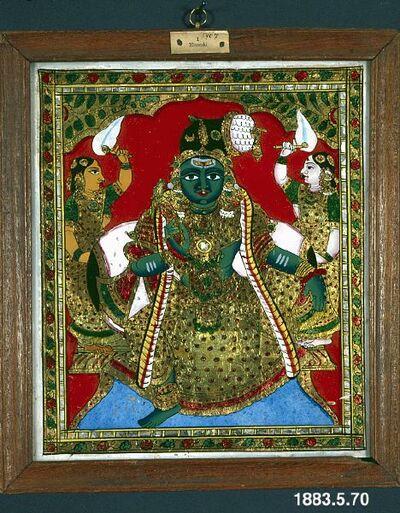
Sri Meenakshi with Shiva Tilak (para-tilaka) in her forehead, flanked by two servants who fan her.
The “fish-eyed” goddess, who, together with her gemhole Sundareshwarar (a manifestation of Shiva), is revered in the Sri Meenakshi temple, Madurai. The goddess Meenakshi, who became the wife of Shiva, is the city goddess of Madurai and was the national goddess of the pandyarik in the past.
The pandyafurst Malayathuvasan and his parapet and Queen Kanchanamala, who reigned in Madurai, were unable to have children, and had unsuccessfully long perpetuated sacrificial ceremonies (yajna) in the hope of being blessed with one. But suddenly, during a ceremony, a three-year-old girl rushed out of the sacred sacrificial fire (agni) and crept up the queen’s knee. He was disappointed that he had not had a son and was concerned that the girl had three breasts, but was reassured when a voice told him that the third breast would disappear when she meets her next husband. Meenaskhi grew up, succeeded his father on the throne and set out to conquer the world. After defeating almost all the world’s armies, Meenakski and her soldiers reached Mount Kailasa, in the Himalayas, where Shiva has her boning. When the army force deployed by Shiva was defeated by Meenakshi, he eventually entered the battle. When Meenaskhi caught sight of him, her third breast suddenly disappeared. She trembled with fear but was told by her insinuations about the prophecy and understood that Shiva was her future husband. Shortly afterwards, their wedding was held in Madurai, with Shiva taking the name Sundara Pandya and they then ruled together the pandyaric. They eventually gave birth to a son, Ugra Pandya (who is identified with Skanda/Karttikeya/Murugan), who succeeded his parents on the throne. (Fuller, 1984: 1; Palaniappan, 1970: 31 f.)
Sri Meenakshi is an example of how a local village goddess (grama-devata), elevated to city god and in ancient times to empire god, has undergone “Sanskritization,” d v s incorporated into the pantheon of Hindu Sanskrit. These goddesses are considered “mothers” and are referred to in southern India as amman and north matrka. Another example is Kamakshiamman in Kancipuram. The myth of Meenakshi also denounces that she is actually an incarnation of Shiva’s Parvati. The Queen had also been a childless and then directed prayers to Parvati for help. Parvati had thus revealed himself in the form of a little girl and, at the Queen’s wish, promised to be reborn as the Queen’s Daughter in the next existence. (Palaniappan, 1970: 32.) As a village has expanded, its local divinity has also gained greater importance. But she still enjoys cult in the villages today. Among other things, she is revered by a fisherman’s throw along with the semi-god Madurai Viran sitting on fish. (Whitehead, 1983: 24 f.) (Niklas, 2000) [ocr]
Title: glasmålning, målning, painting
Description:
Name of.
Madura’s guardian gudi (the catalogue general, ocr)
Minacshi
Sri Meenakshi with Shiva Tilak (para-tilaka) in her forehead, flanked by two servants who fan her.
The “fish-eyed” goddess, who, together with her gemhole Sundareshwarar (a manifestation of Shiva), is revered in the Sri Meenakshi temple, Madurai.
The goddess Meenakshi, who became the wife of Shiva, is the city goddess of Madurai and was the national goddess of the pandyarik in the past.
The pandyafurst Malayathuvasan and his parapet and Queen Kanchanamala, who reigned in Madurai, were unable to have children, and had unsuccessfully long perpetuated sacrificial ceremonies (yajna) in the hope of being blessed with one.
But suddenly, during a ceremony, a three-year-old girl rushed out of the sacred sacrificial fire (agni) and crept up the queen’s knee.
He was disappointed that he had not had a son and was concerned that the girl had three breasts, but was reassured when a voice told him that the third breast would disappear when she meets her next husband.
Meenaskhi grew up, succeeded his father on the throne and set out to conquer the world.
After defeating almost all the world’s armies, Meenakski and her soldiers reached Mount Kailasa, in the Himalayas, where Shiva has her boning.
When the army force deployed by Shiva was defeated by Meenakshi, he eventually entered the battle.
When Meenaskhi caught sight of him, her third breast suddenly disappeared.
She trembled with fear but was told by her insinuations about the prophecy and understood that Shiva was her future husband.
Shortly afterwards, their wedding was held in Madurai, with Shiva taking the name Sundara Pandya and they then ruled together the pandyaric.
They eventually gave birth to a son, Ugra Pandya (who is identified with Skanda/Karttikeya/Murugan), who succeeded his parents on the throne.
(Fuller, 1984: 1; Palaniappan, 1970: 31 f.
)
Sri Meenakshi is an example of how a local village goddess (grama-devata), elevated to city god and in ancient times to empire god, has undergone “Sanskritization,” d v s incorporated into the pantheon of Hindu Sanskrit.
These goddesses are considered “mothers” and are referred to in southern India as amman and north matrka.
Another example is Kamakshiamman in Kancipuram.
The myth of Meenakshi also denounces that she is actually an incarnation of Shiva’s Parvati.
The Queen had also been a childless and then directed prayers to Parvati for help.
Parvati had thus revealed himself in the form of a little girl and, at the Queen’s wish, promised to be reborn as the Queen’s Daughter in the next existence.
(Palaniappan, 1970: 32.
) As a village has expanded, its local divinity has also gained greater importance.
But she still enjoys cult in the villages today.
Among other things, she is revered by a fisherman’s throw along with the semi-god Madurai Viran sitting on fish.
(Whitehead, 1983: 24 f.
) (Niklas, 2000) [ocr].
Related Results
painting, painting, painting, painting, painting, painting, painting, painting, painting, painting, painting, painting, painting, painting, painting, painting, painting, painting, painting, painting, painting, painting, painting, painting, painting, paint
painting, painting, painting, painting, painting, painting, painting, painting, painting, painting, painting, painting, painting, painting, painting, painting, painting, painting, painting, painting, painting, painting, painting, painting, painting, paint
"Here is portrayed three Moods of the Sky and the effects on the Fish and Animals. Sharks and Turtles come to the Surface when it is Raining. Wallabies and Kangaroos are out feedin...
målning, glasmålning, painting
målning, glasmålning, painting
See the above preamble, 1/Isvara oth Parvati, Isvara or Siva is one of the Trinity worshiped by Sivaitis in the temples Parjati (the one on the mountain gave birth) is by Sivaitis ...