
Search engine for discovering works of Art, research articles, and books related to Art and Culture



Javascript must be enabled to continue!
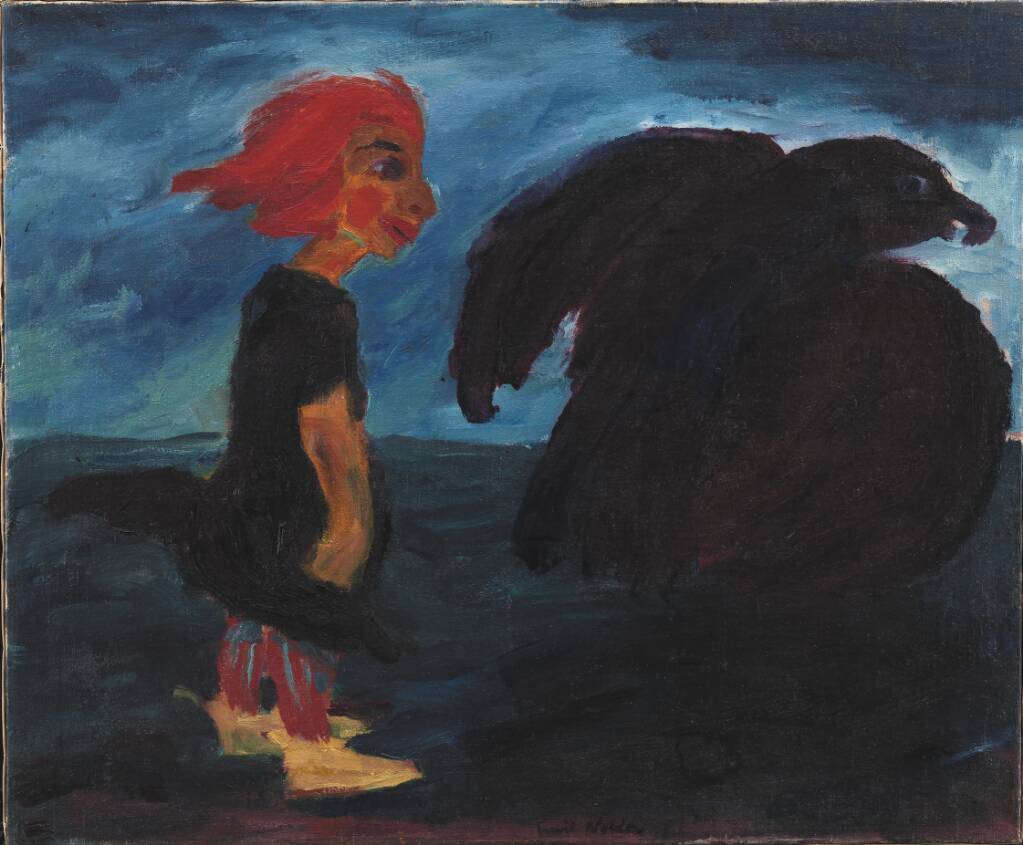
Child and Large Bird
View through National Gallery of Denmark
Emil Nolde’s works from around 1912 often feature grotesque juxtapositions. Child and Large Bird is one example of such works with its surrealist proportions and absurd combination of figures. The bird is frighteningly large compared to the child. Nevertheless, its superior size does not prevent it from being scared away by the little girl’s peculiar physique. The girl’s head is too large in proportion to the thin neck and the tiny body. Her nose is too broad, her forehead too low, and her mouth too wide. The grotesque relationship between the child and the bird is further accentuated by Nolde’s use of an expressive colour scheme. The colours are bright and fervent, full of discord. The grim aspect of the painting Things were looking grim in Germany in 1912. The country was on the brink of the Great War. The child can be interpreted as life chasing away darkness, death, and war as embodied by the eagle, a symbol of Germany. Nolde addressed the same motif in a number of woodcuts from 1906. Those images were less eerie, as the relative dimensions of the bird and the girl were less distorted and the colour scheme was black and white. Nolde is one of the key figures within German Expressionism. His art is powerful and deeply felt, partly inspired by the dark and sombre visions of the German Symbolist painter Arnold Böcklin (1827-1901).
Title: Child and Large Bird
Description:
Emil Nolde’s works from around 1912 often feature grotesque juxtapositions.
Child and Large Bird is one example of such works with its surrealist proportions and absurd combination of figures.
The bird is frighteningly large compared to the child.
Nevertheless, its superior size does not prevent it from being scared away by the little girl’s peculiar physique.
The girl’s head is too large in proportion to the thin neck and the tiny body.
Her nose is too broad, her forehead too low, and her mouth too wide.
The grotesque relationship between the child and the bird is further accentuated by Nolde’s use of an expressive colour scheme.
The colours are bright and fervent, full of discord.
The grim aspect of the painting Things were looking grim in Germany in 1912.
The country was on the brink of the Great War.
The child can be interpreted as life chasing away darkness, death, and war as embodied by the eagle, a symbol of Germany.
Nolde addressed the same motif in a number of woodcuts from 1906.
Those images were less eerie, as the relative dimensions of the bird and the girl were less distorted and the colour scheme was black and white.
Nolde is one of the key figures within German Expressionism.
His art is powerful and deeply felt, partly inspired by the dark and sombre visions of the German Symbolist painter Arnold Böcklin (1827-1901).
Related Results
Modeled, engraved and openwork perfume burner in bronze. Cylindrical base with flat bottom and flat rim on which a niche in the shape of a half dome. The opening is framed by a carved rim forming two opposing volutes, with two bird heads in the centre. On
Modeled, engraved and openwork perfume burner in bronze. Cylindrical base with flat bottom and flat rim on which a niche in the shape of a half dome. The opening is framed by a carved rim forming two opposing volutes, with two bird heads in the centre. On
Modeled, engraved and openwork perfume burner in bronze. Cylindrical base with flat bottom and flat rim on which a niche in the shape of a half dome. The opening is framed by a car...
Xiang Huidi, the roster: mary, suzy, perla, sister #4, sister #5, sister #6, jaq, gus, bert, mert, luke, mouse #12, mouse #13, bird #1, bird #2, bird #3, bird #4, bird #5, bird #6, bird #7 (2024)
Xiang Huidi, the roster: mary, suzy, perla, sister #4, sister #5, sister #6, jaq, gus, bert, mert, luke, mouse #12, mouse #13, bird #1, bird #2, bird #3, bird #4, bird #5, bird #6, bird #7 (2024)
20 3D-printed aluminum alloy objects, 2 × 2 × 2 in...
Jules David. Two women's day dresses by R. Lhopiteau and Pauline Conter, and a child's dress, for Le Moniteur de la Mode, c.1862. Outside scene with two women in day dresses with large crinolines, one white with pink flower pattern and sheer full sleeves,
Jules David. Two women's day dresses by R. Lhopiteau and Pauline Conter, and a child's dress, for Le Moniteur de la Mode, c.1862. Outside scene with two women in day dresses with large crinolines, one white with pink flower pattern and sheer full sleeves,
Jules David. Two women's day dresses by R. Lhopiteau and Pauline Conter, and a child's dress, for Le Moniteur de la Mode, c.1862. Outside scene with two women in day dresses with l...
The Virgin and Child with Angels
The Virgin and Child with Angels
The Virgin and Child with Angels was in a private English collection, entering the Thyssen-Bornemisza collection in 1933 via the Sanct Lucas gallery in Vienna. The painting has bee...
painting (oil): ["Madonna and Child with St. Mark"]
painting (oil): ["Madonna and Child with St. Mark"]
The Virgin and Child are seated in a landscape. The Virgin, wearing a pink robe, holds the swaddled Christ child up towards a dark-haired man who kneels before them, his hands pres...
Small Dish with Stylized Rock Dove
Small Dish with Stylized Rock Dove
Except for the brown rim, all the decoration on this small, round dish is painted in shades of cobalt blue. A rotund bird with backward-turning head neatly fills the interior. Arou...
Booties for mannequin
Booties for mannequin
"(Western?) Apache moccasins for a doll; buckskin, sinew, glass beads; l. (of sole) 5 cm., h. 9 cm., w. 2.5 cm.; ca. 1880.\These beaded miniature high-top moccasins with toe tabs a...
Bowl with Bird and Flowers
Bowl with Bird and Flowers
The decoration on the interior of this vessel is characteristic of slip-painted wares now generally attributed to workshops in a region south of the Caspian Sea. Typically, as here...