
Search engine for discovering works of Art, research articles, and books related to Art and Culture


Javascript must be enabled to continue!
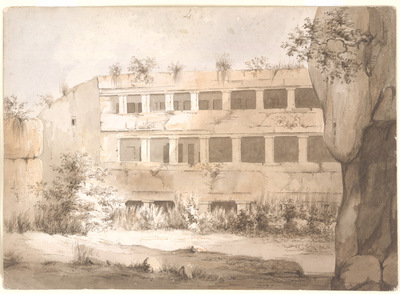
Inscribed on reverse: 'Tin Tal Cave Ellora. March 1847'
View through Europeana Collections
Water-colour by Charles Power Cobbe of the Tin
Tal Cave at Ellora, dated March 1847. Inscribed on reverse: 'Tin
Tal Cave Ellora. March 1847 CPC'.Charles Power Cobbe was in the 8th
Foot Regiment which was stationed at Poona and Bombay from 1846 to
1848.The spectacular site of Ellora is famous for its series of
Hindu, Buddhist and Jain cave temples excavated into the rocky
façade of a cliff of basalt. The works were done under the
patronage of the Kalachuri, the Chalukya and the Rashtrakuta
dynasties between the 6th and the 9th Centuries. Tin-Thal is a
Buddhist excavation which dates probably from about the 8th
century. It consists of a broad forecourt with three superimposed
halls extending deep into the cliff. The pillars are square and
have simple brackets capitals. The halls were used for
congregational purposes and each was provided with a sanctuary with
a seated Buddha and Bodhisattva attendants.
Title: Inscribed on reverse: 'Tin Tal Cave Ellora. March
1847'
Description:
Water-colour by Charles Power Cobbe of the Tin
Tal Cave at Ellora, dated March 1847.
Inscribed on reverse: 'Tin
Tal Cave Ellora.
March 1847 CPC'.
Charles Power Cobbe was in the 8th
Foot Regiment which was stationed at Poona and Bombay from 1846 to
1848.
The spectacular site of Ellora is famous for its series of
Hindu, Buddhist and Jain cave temples excavated into the rocky
façade of a cliff of basalt.
The works were done under the
patronage of the Kalachuri, the Chalukya and the Rashtrakuta
dynasties between the 6th and the 9th Centuries.
Tin-Thal is a
Buddhist excavation which dates probably from about the 8th
century.
It consists of a broad forecourt with three superimposed
halls extending deep into the cliff.
The pillars are square and
have simple brackets capitals.
The halls were used for
congregational purposes and each was provided with a sanctuary with
a seated Buddha and Bodhisattva attendants.
Related Results
f.25 Dumar Lena Cave with sculpture of Ravana rocking Mount
Kailasa, Cave 29, Ellora. 'Entrance to Dhurma Lena. Septr.
25.'
f.25 Dumar Lena Cave with sculpture of Ravana rocking Mount
Kailasa, Cave 29, Ellora. 'Entrance to Dhurma Lena. Septr.
25.'
Wash and watercolour drawing of the sculpture of
Ravana shaking Mount Kailasa from Dhumar Lena, Cave 29 at Ellora,
from an Album of 83 drawings; 80 of landscapes and antiquities in...
f.28 Entrance to Dumar Lena Cave with sculpture of Siva's
Dance in the Elephant Skin, Cave 29, Ellora. 'Dhurma Lena. 26
Sept.'
f.28 Entrance to Dumar Lena Cave with sculpture of Siva's
Dance in the Elephant Skin, Cave 29, Ellora. 'Dhurma Lena. 26
Sept.'
Wash and watercolour drawing of the Dhumar Lena,
Cave 29 at Ellora, from an Album of 83 drawings; 80 of landscapes
and antiquities in the northem Deccan, 2 portraits and 1 flower
s...
Personifications of medicine, pharmacy and surgery. Oil painting after (?) Nicolas de Larmessin II (1638-1694).
Personifications of medicine, pharmacy and surgery. Oil painting after (?) Nicolas de Larmessin II (1638-1694).
Lettering: Inscriptions on the surgical equipment which forms the costume of the surgeon are as follows. On the instrument on his head: Eleuatoire po' la Teste. On his right arm: B...
Personifications of medicine, pharmacy and surgery. Oil painting after (?) Nicolas de Larmessin II (1638-1694).
Personifications of medicine, pharmacy and surgery. Oil painting after (?) Nicolas de Larmessin II (1638-1694).
Lettering: Inscriptions on the surgical equipment which forms the costume of the surgeon are as follows. On the instrument on his head: Eleuatoire po' la Teste. On his right arm: B...
Personifications of medicine, pharmacy and surgery. Oil painting after (?) Nicolas de Larmessin II (1638-1694).
Personifications of medicine, pharmacy and surgery. Oil painting after (?) Nicolas de Larmessin II (1638-1694).
Lettering: Inscriptions on the surgical equipment which forms the costume of the surgeon are as follows. On the instrument on his head: Eleuatoire po' la Teste. On his right arm: B...
Personifications of medicine, pharmacy and surgery. Oil painting after (?) Nicolas de Larmessin II (1638-1694).
Personifications of medicine, pharmacy and surgery. Oil painting after (?) Nicolas de Larmessin II (1638-1694).
Lettering: Inscriptions on the surgical equipment which forms the costume of the surgeon are as follows. On the instrument on his head: Eleuatoire po' la Teste. On his right arm: B...
Entrance to the cave temple of Karle. Copy of an original
sketch of 1805
Entrance to the cave temple of Karle. Copy of an original
sketch of 1805
Water-colour by James Broff Byers of the entrance
to the cave temple of Karle, dated 1815. Inscribed on reverse:
'View of the Entrance, or External Appearance of the magnificent
Ca...
General view of cave temples in the Barabar Hills, Gaya
(Bihar). January 1814
General view of cave temples in the Barabar Hills, Gaya
(Bihar). January 1814
Water-colour of the cave temples in the Barabar
Hills, at Gaya in Bihar, dated January 1814. Inscribed on front in
ink: 'View of the Rock of the Caverns at - mile from Ghya.' '
Jan...