
Search engine for discovering works of Art, research articles, and books related to Art and Culture


Javascript must be enabled to continue!
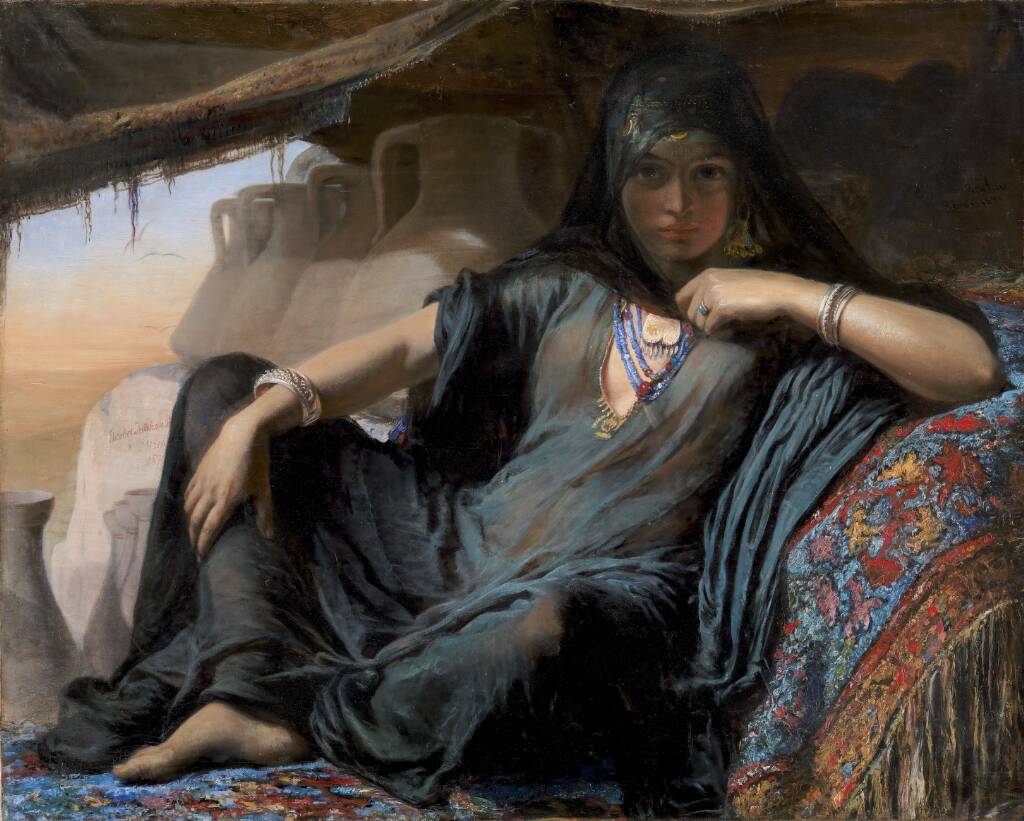
An Egyptian Pot Seller at Gizeh
View through National Gallery of Denmark
The gaze is direct and confident. The woman puts her body on
display, but as a viewer you are also confronted with your own
desire to look: your desire is exposed too.
Danish nineteenth-century art rarely gets more
sensuous than Elisabeth Jerichau-Baumann’s depiction of an
Egyptian pot seller. The woman adopts an inviting, relaxed
pose, her naked body faintly visible under the thin silk. The
densely colourful rug and shiny jewellery are painted with
a fine feel for surfaces and materiality. In 1869–1870 and
1874–1875 the artist visited Constantinople, and the sights she
saw there became a rich reservoir of artistic subject matter.
During the first trip she visited Egypt in 1870 and became
fascinated by the pottery sellers on the Nile.
Jerichau-Baumann was an outsider on the Danish
art scene of her day. She was a woman, of Polish-German
descent, and had an international education. And whereas
most other artists in Denmark were preoccupied with
portraying the nation’s most distinctive traits, she was
interested in all things cosmopolitan and – in the eyes of
Danish audiences of the time – foreign (50 Favorites in the SMK Collection).
Værkdatering: 1876-78
Maleriet blev ifølge påskrifterne på maleriet påbegyndt i Ægypten i 1876 og fuldført i Rom i 1878, men kunstneren var tilsyneladende ikke i Gizeh i 1876.
Title: An Egyptian Pot Seller at Gizeh
Description:
The gaze is direct and confident.
The woman puts her body on
display, but as a viewer you are also confronted with your own
desire to look: your desire is exposed too.
Danish nineteenth-century art rarely gets more
sensuous than Elisabeth Jerichau-Baumann’s depiction of an
Egyptian pot seller.
The woman adopts an inviting, relaxed
pose, her naked body faintly visible under the thin silk.
The
densely colourful rug and shiny jewellery are painted with
a fine feel for surfaces and materiality.
In 1869–1870 and
1874–1875 the artist visited Constantinople, and the sights she
saw there became a rich reservoir of artistic subject matter.
During the first trip she visited Egypt in 1870 and became
fascinated by the pottery sellers on the Nile.
Jerichau-Baumann was an outsider on the Danish
art scene of her day.
She was a woman, of Polish-German
descent, and had an international education.
And whereas
most other artists in Denmark were preoccupied with
portraying the nation’s most distinctive traits, she was
interested in all things cosmopolitan and – in the eyes of
Danish audiences of the time – foreign (50 Favorites in the SMK Collection).
Related Results
pot / jug / ewer
pot / jug / ewer
Covered jug, holy, hexagonal shape over hexagonal foot with panther handle, mascaron spout and arched lid with knob. At the lower and upper edges of the pot as well as at the cover...
dockhusgeråd
dockhusgeråd
1 coffee pot with lid, white porcelain with gold decor and flower in red and green, H 5.5 cm.
1 coffee pot without lid in white porcelain, gold decor and print with the coat of ar...
Master of the Poultry Seller, The Poultry Seller (Late 17th Century)
Master of the Poultry Seller, The Poultry Seller (Late 17th Century)
Oil on canvas, 100 × 83 × 9 cm...
painting (oil): "British Artillery Entering the Enemy's Lines at Tel-El-Kebir, 13th September 1882"
painting (oil): "British Artillery Entering the Enemy's Lines at Tel-El-Kebir, 13th September 1882"
In a ditch in the foreground on the right are two British and three Egyptian men. From the left is a dead Egyptian, his bayonet and a tin showing an Egyptian flag lie on the ground...
1. Pot à Oille, 2. Fontaine à thé, 3. Vases exécutes à Paris
1. Pot à Oille, 2. Fontaine à thé, 3. Vases exécutes à Paris
Vases / Jugs / Goblets / Bowls. Inscriptions and textual elements: Pl. 34. Inscriptions and textual elements: Par Percier et Fontaine. Inscriptions and textual elements: N°. 1. Pot...