
Search engine for discovering works of Art, research articles, and books related to Art and Culture


Javascript must be enabled to continue!
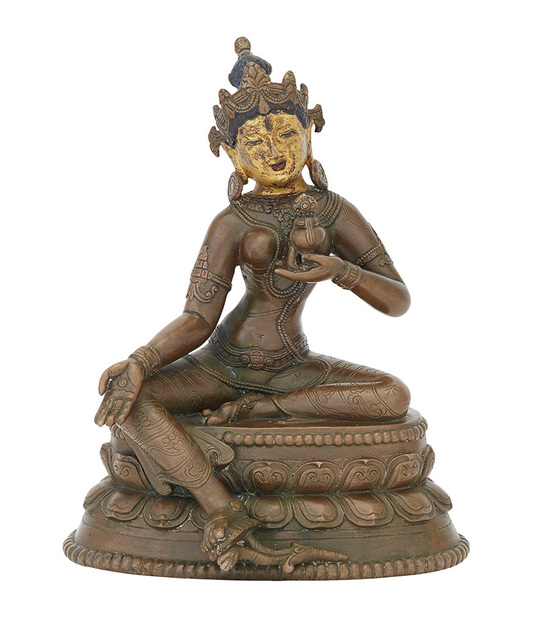
Tibetan Bronze Figure of Tara (15th/16th Century)
View through Artsy
Syama Tara with the third eye, seated in lalitasana on a double lotus base, wearing the diadem and jewels of a Bodhisattva, the hands in the the Boon-Giving Mudra and holding a pot of nectar, inscribed in Tibetan Uchen script on the base reads Homage to the holy Tara Ushnisha Vijaya., 7 1/2 in
Title: Tibetan Bronze Figure of Tara (15th/16th Century)
Description:
Syama Tara with the third eye, seated in lalitasana on a double lotus base, wearing the diadem and jewels of a Bodhisattva, the hands in the the Boon-Giving Mudra and holding a pot of nectar, inscribed in Tibetan Uchen script on the base reads Homage to the holy Tara Ushnisha Vijaya.
, 7 1/2 in.
Related Results
Hill of Tara Archaeological Complex (Images)
Hill of Tara Archaeological Complex (Images)
Tara is chief among the best known ‘royal’ sites of Ireland, including Dún Ailinne in Leinster, Crúachain in Connacht and Emain Macha in Ulster. It is at once a landmark and a vant...
Hill of Tara Archaeological Complex (3D Model, hill-shade texture)
Hill of Tara Archaeological Complex (3D Model, hill-shade texture)
Tara is chief among the best known ‘royal’ sites of Ireland, including Dún Ailinne in Leinster, Crúachain in Connacht and Emain Macha in Ulster. It is at once a landmark and a vant...
Hill of Tara Archaeological Complex (Turntable Movie)
Hill of Tara Archaeological Complex (Turntable Movie)
Tara is chief among the best known ‘royal’ sites of Ireland, including Dún Ailinne in Leinster, Crúachain in Connacht and Emain Macha in Ulster. It is at once a landmark and a vant...
Seated Medicine Buddha (Sanskrit: Bhaishajyaguru)
Seated Medicine Buddha (Sanskrit: Bhaishajyaguru)
The central figure in this Tibetan Buddhist painting, or thangka, is Bhaisajyaguru—the buddha of healing and medicine known more commonly as the Medicine Buddha. Seated on an elabo...
Late Bronze Age, Bronze Cauldron, HCA 458
Late Bronze Age, Bronze Cauldron, HCA 458
This bronze cauldron was discovered at Toome near Ballyscullion, Co. Antrim. The body and rim are made from eight pieces of beaten bronze, each hammered to a thickness of about 1mm...
Central Italian 15th or 16th Century (Possibly Roman 15th or 16th Century), The Capitoline Wolf Suckling Romulus and Remus (late 15th -early 16th century)
Central Italian 15th or 16th Century (Possibly Roman 15th or 16th Century), The Capitoline Wolf Suckling Romulus and Remus (late 15th -early 16th century)
Bronze, 14 15/16 × 25 1/4 × 6 1/4 in...