
Search engine for discovering works of Art, research articles, and books related to Art and Culture


Javascript must be enabled to continue!
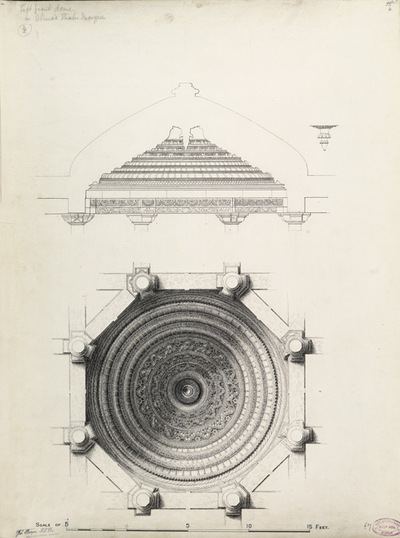
Ahmadabad: Left front dome in Ahmad Shah's mosque
View through Europeana Collections
Illustration of left front dome in Ahmad Shah's
mosque in Ahmadabad, Gujarat from James Burgess' 'Original Drawings
[of] Muhammadan Architecture of Ahmadabad.' Sultan Ahmad Shah
(r.1411-42) founded the city of Ahmadabad in 1411 and was
responsible for the construction of several buildings and mosques.
His Ahmad Shah mosque, also known as the Chhoti Jumna Mosque, was
built in Ahmadabad's citadel and completed in 1414. An Arabic
inscription over the central mihrab records that the mosque was
built by Ahmad Shah in 1414. The ground plan of the Ahmad Shah
mosque is based on the Jami Masjid in Cambay, built in 1325. The
roof is covered with ten large domes and other smaller ones
between. Key features of this mosque include the eight
perforated stone windows which light the interior and the use of
pillars, which originated from an earlier Hindu temple, to support
the domes which demonstrate the fusion of Islamic and Hindu
architectural styles.
Title: Ahmadabad: Left front dome in Ahmad Shah's mosque
Description:
Illustration of left front dome in Ahmad Shah's
mosque in Ahmadabad, Gujarat from James Burgess' 'Original Drawings
[of] Muhammadan Architecture of Ahmadabad.
' Sultan Ahmad Shah
(r.
1411-42) founded the city of Ahmadabad in 1411 and was
responsible for the construction of several buildings and mosques.
His Ahmad Shah mosque, also known as the Chhoti Jumna Mosque, was
built in Ahmadabad's citadel and completed in 1414.
An Arabic
inscription over the central mihrab records that the mosque was
built by Ahmad Shah in 1414.
The ground plan of the Ahmad Shah
mosque is based on the Jami Masjid in Cambay, built in 1325.
The
roof is covered with ten large domes and other smaller ones
between.
 Key features of this mosque include the eight
perforated stone windows which light the interior and the use of
pillars, which originated from an earlier Hindu temple, to support
the domes which demonstrate the fusion of Islamic and Hindu
architectural styles.
Related Results
Mughal emperors Akbar, Jahangir and Shah Jahan with their ministers, by Bichitr (recto), foliate design in gold (verso), folio from the Minto Album
Mughal emperors Akbar, Jahangir and Shah Jahan with their ministers, by Bichitr (recto), foliate design in gold (verso), folio from the Minto Album
Mughal emperors Akbar, Jahangir and Shah Jahan with their ministers, by Bichitr (recto), foliate design in gold (verso), folio from the Minto Album.
This allegorical group portra...
Emperor Leopold I elevates Mark Putz von Adlersthurn, court chamber council and secret secretary, to the old knight’s state, improves his coat of arms and improves his predicate on von Putz zu Adlerßthurn and grants him a new predicate Edler von Schrotten
Emperor Leopold I elevates Mark Putz von Adlersthurn, court chamber council and secret secretary, to the old knight’s state, improves his coat of arms and improves his predicate on von Putz zu Adlerßthurn and grants him a new predicate Edler von Schrotten
Character: description on folk. 5b and 6a, miniature on folk. 5a, 166 x 151 mm.
Quarter shield with crowned heart plate. It is red with a silver crossbar, above the crossbar is the...
Shah Jahan on a globe with his four sons, by Balchand (recto), Persian calligraphy by Mir `Ali (verso), folio from the Minto Album
Shah Jahan on a globe with his four sons, by Balchand (recto), Persian calligraphy by Mir `Ali (verso), folio from the Minto Album
Shah Jahan on a globe with his four sons, signed Balchand (recto), Persian calligraphy signed Mir `Ali (verso), folio from the Minto Album.
In this allegorical family portrait, S...
Portrait of Mahābat Khān (d. 1634) (recto), Persian calligraphy by Mīr `Alī (verso), from the Late Shah Jahan Album
Portrait of Mahābat Khān (d. 1634) (recto), Persian calligraphy by Mīr `Alī (verso), from the Late Shah Jahan Album
Portrait of Mahābat Khān (d. 1634) (recto), Persian calligraphy by Mīr `Alī (verso), from the Late Shah Jahan Album.
Zamāna Beg (d. 1634) was the son of a nobleman from Shiraz i...
Portrait of Shāhnavāz Khān Ṣafavī (d. 1659) by Hāshim (recto), Persian calligraphy by Mīr `Alī (verso), folio from the Minto Album
Portrait of Shāhnavāz Khān Ṣafavī (d. 1659) by Hāshim (recto), Persian calligraphy by Mīr `Alī (verso), folio from the Minto Album
Portrait of Shāhnavāz Khān Ṣafavī (d. 1659) by Hāshim (recto), Persian calligraphy by Mīr `Alī (verso), folio from the Minto Album.
Many of the Mughal emperors ordered full-leng...
dome, domé, portrait, staircase, photograph, ph
dome, domé, portrait, staircase, photograph, ph
Motif: The photographer on the house staircase (domé).
Room: Rio Chicué, Atrato, Chocó, Colombia.
Shame: Emberá/chocó.
Photo by: Sven-Erik Isacsson. Dato: 1972.
Erh.: to the archiv...
Modeled, engraved and openwork perfume burner in bronze. Cylindrical base with flat bottom and flat rim on which a niche in the shape of a half dome. The opening is framed by a carved rim forming two opposing volutes, with two bird heads in the centre. On
Modeled, engraved and openwork perfume burner in bronze. Cylindrical base with flat bottom and flat rim on which a niche in the shape of a half dome. The opening is framed by a carved rim forming two opposing volutes, with two bird heads in the centre. On
Modeled, engraved and openwork perfume burner in bronze. Cylindrical base with flat bottom and flat rim on which a niche in the shape of a half dome. The opening is framed by a car...
Altenburg (Lower Austria). Collegiate Church (1730-1733; J. Munggenast). Upper part of the wall structure, dome tambour and part of the dome fresco by P. Troger
Altenburg (Lower Austria). Collegiate Church (1730-1733; J. Munggenast). Upper part of the wall structure, dome tambour and part of the dome fresco by P. Troger
Altenburg (Lower Austria). Collegiate Church (1730-1733; J. Munggenast). Upper part of the wall structure, dome tambour and part of the dome fresco by P. Troger...