
Search engine for discovering works of Art, research articles, and books related to Art and Culture


Javascript must be enabled to continue!
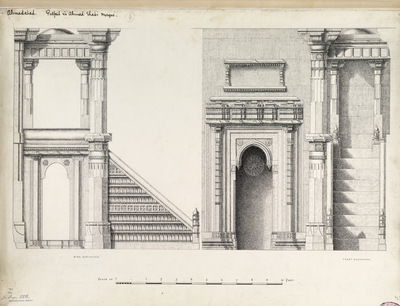
Ahmadabad: Pulpit in Ahmad Shah's mosque
View through Europeana Collections
Pulpit in Ahmad Shah's mosque in Ahmadabad,
Gujarat from James Burgess' 'Original Drawings [of] Muhammadan
Architecture of Ahmadabad.' Sultan Ahmad Shah (r.1411-42) founded
the city of Ahmadabad in 1411 and was responsible for the
construction of several buildings and mosques. His Ahmad Shah
mosque, also known as the Chhoti Jumna Mosque, was built in
Ahmadabad's citadel and completed in 1414. An Arabic inscription
over the central mihrab records that the mosque was built by Ahmad
Shah in 1414. The ground plan of the Ahmad Shah mosque is based on
the Jami Masjid in Cambay, built in 1325. The roof is covered with
ten large domes and other smaller ones between. Key features
of this mosque include the eight perforated stone windows which
light the interior and the use of pillars, which originated from an
earlier Hindu temple, to support the domes which demonstrate the
fusion of Islamic and Hindu architectural
styles.
Title: Ahmadabad: Pulpit in Ahmad Shah's mosque
Description:
Pulpit in Ahmad Shah's mosque in Ahmadabad,
Gujarat from James Burgess' 'Original Drawings [of] Muhammadan
Architecture of Ahmadabad.
' Sultan Ahmad Shah (r.
1411-42) founded
the city of Ahmadabad in 1411 and was responsible for the
construction of several buildings and mosques.
His Ahmad Shah
mosque, also known as the Chhoti Jumna Mosque, was built in
Ahmadabad's citadel and completed in 1414.
An Arabic inscription
over the central mihrab records that the mosque was built by Ahmad
Shah in 1414.
The ground plan of the Ahmad Shah mosque is based on
the Jami Masjid in Cambay, built in 1325.
The roof is covered with
ten large domes and other smaller ones between.
 Key features
of this mosque include the eight perforated stone windows which
light the interior and the use of pillars, which originated from an
earlier Hindu temple, to support the domes which demonstrate the
fusion of Islamic and Hindu architectural
styles.
Related Results
Mughal emperors Akbar, Jahangir and Shah Jahan with their ministers, by Bichitr (recto), foliate design in gold (verso), folio from the Minto Album
Mughal emperors Akbar, Jahangir and Shah Jahan with their ministers, by Bichitr (recto), foliate design in gold (verso), folio from the Minto Album
Mughal emperors Akbar, Jahangir and Shah Jahan with their ministers, by Bichitr (recto), foliate design in gold (verso), folio from the Minto Album.
This allegorical group portra...
Portrait of Mahābat Khān (d. 1634) (recto), Persian calligraphy by Mīr `Alī (verso), from the Late Shah Jahan Album
Portrait of Mahābat Khān (d. 1634) (recto), Persian calligraphy by Mīr `Alī (verso), from the Late Shah Jahan Album
Portrait of Mahābat Khān (d. 1634) (recto), Persian calligraphy by Mīr `Alī (verso), from the Late Shah Jahan Album.
Zamāna Beg (d. 1634) was the son of a nobleman from Shiraz i...
Shah Jahan on a globe with his four sons, by Balchand (recto), Persian calligraphy by Mir `Ali (verso), folio from the Minto Album
Shah Jahan on a globe with his four sons, by Balchand (recto), Persian calligraphy by Mir `Ali (verso), folio from the Minto Album
Shah Jahan on a globe with his four sons, signed Balchand (recto), Persian calligraphy signed Mir `Ali (verso), folio from the Minto Album.
In this allegorical family portrait, S...
Dagger with Sheath
Dagger with Sheath
The blade of this dagger, which has a very fine watered steel pattern, was made in 1800-01, around 30 years before the hilt. The inscription on the hilt says that it was made in K...
Portrait of Shāhnavāz Khān Ṣafavī (d. 1659) by Hāshim (recto), Persian calligraphy by Mīr `Alī (verso), folio from the Minto Album
Portrait of Shāhnavāz Khān Ṣafavī (d. 1659) by Hāshim (recto), Persian calligraphy by Mīr `Alī (verso), folio from the Minto Album
Portrait of Shāhnavāz Khān Ṣafavī (d. 1659) by Hāshim (recto), Persian calligraphy by Mīr `Alī (verso), folio from the Minto Album.
Many of the Mughal emperors ordered full-leng...
Some of the worshippers at
Some of the worshippers at
Some of the worshippers at the Eid Festival at the Mosque in Woking , Surrey ._x000D_
29 September 1917 _x000D_
The Shah Jahan Mosque was the first purpose built mosque in Europe ...
Shah Abbas Receiving Khan Alam in 1618
Shah Abbas Receiving Khan Alam in 1618
The painting depicts Safavid Persian ruler Shah Abbas I (r. 1588-1629) receiving Mughal Ambassador Khan Alam. Shah Abbas’s head is surrounded by a large green halo with emanating g...
Calligraphic panel showing stylized views of Mecca and Medina and Sandals of the Prophet Muhammad
Calligraphic panel showing stylized views of Mecca and Medina and Sandals of the Prophet Muhammad
This large panel, created in Ouazzane, Morocco, is divided into rectangular sections that contain Arabic inscriptions in a variety of colors and scripts (naskh, thuluth, muhaqqaq, ...