
Search engine for discovering works of Art, research articles, and books related to Art and Culture


Javascript must be enabled to continue!
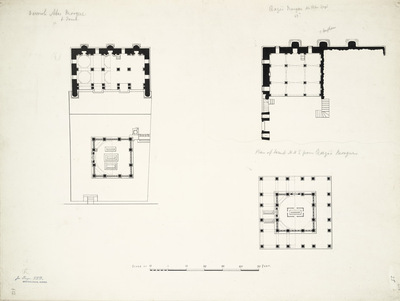
Darvish Alis mosque and tomb (left); Qazir Mosque Ali Qazi (top right); Plan of tombs N and E from Qazir mosque (bottom right)
View through Europeana Collections
Plan of the Darvish Ali mosque near Ahmadabad, in
Gujarat. The Darvish Ali mosque, also referred to as the Khonja
Bibi mosque, has an inscription dating the building to 1504. This
small mosque consists of an interior extending to 37 feet in length
and utilizes four key pillars to support a roof consisting of six
domes in two rows. The richly decorated minarets, niches, mihrab,
and windows are key features of this mosque and show similarities
in style with the Rani Sipri mosque also in
Ahmadabad.
Title: Darvish Alis mosque and tomb (left); Qazir Mosque Ali Qazi
(top right); Plan of tombs N and E from Qazir mosque (bottom
right)
Description:
Plan of the Darvish Ali mosque near Ahmadabad, in
Gujarat.
The Darvish Ali mosque, also referred to as the Khonja
Bibi mosque, has an inscription dating the building to 1504.
This
small mosque consists of an interior extending to 37 feet in length
and utilizes four key pillars to support a roof consisting of six
domes in two rows.
The richly decorated minarets, niches, mihrab,
and windows are key features of this mosque and show similarities
in style with the Rani Sipri mosque also in
Ahmadabad.
Related Results
Emperor Leopold I elevates Mark Putz von Adlersthurn, court chamber council and secret secretary, to the old knight’s state, improves his coat of arms and improves his predicate on von Putz zu Adlerßthurn and grants him a new predicate Edler von Schrotten
Emperor Leopold I elevates Mark Putz von Adlersthurn, court chamber council and secret secretary, to the old knight’s state, improves his coat of arms and improves his predicate on von Putz zu Adlerßthurn and grants him a new predicate Edler von Schrotten
Character: description on folk. 5b and 6a, miniature on folk. 5a, 166 x 151 mm.
Quarter shield with crowned heart plate. It is red with a silver crossbar, above the crossbar is the...
Emperor Ferdinand III. exalts Danyel Natanyel Kunstát from Krygsfeld, a burgher of the New Town of Prague, to the Czech Vladycký state and awards him a coat of arms
Emperor Ferdinand III. exalts Danyel Natanyel Kunstát from Krygsfeld, a burgher of the New Town of Prague, to the Czech Vladycký state and awards him a coat of arms
Character: description on folk. 3b - 4b, miniature on folk. 4a, 147 x 164 mm.
In the red gable there is a green lawn, on it stands on the right two shirts and on the left there is ...
Bernhardt exalts the Earl zu Orttenburg, on the basis of a palatinate awarded to his ancestor Gabriel the Earl zu Orttenburg by Emperor Charles V. the deed given in Nuremberg 21. March 1524, Georg Sihart born in Nuremberg to a noble state
Bernhardt exalts the Earl zu Orttenburg, on the basis of a palatinate awarded to his ancestor Gabriel the Earl zu Orttenburg by Emperor Charles V. the deed given in Nuremberg 21. March 1524, Georg Sihart born in Nuremberg to a noble state
Character: description, miniature in the middle of the leaf, 111 x 150 mm.
Original: In the shield a man holding a sickle in his right hand and three barley cobs in his left. On th...
Emperor Ferdinand II Improves Samuel Matthyse of the Hostinný coat of arms, authorizes that, should Samuel Mathyseus of Hostinný die without male heirs, the provisions of the deed pass to his wife Samuel Václav and Pavel Havránky, and confirms the predica
Emperor Ferdinand II Improves Samuel Matthyse of the Hostinný coat of arms, authorizes that, should Samuel Mathyseus of Hostinný die without male heirs, the provisions of the deed pass to his wife Samuel Václav and Pavel Havránky, and confirms the predica
Character: description on folk. 3b - 4b, miniature on folk. 4a, 155 x 158 mm.
In the blue shield there is a phoenix of natural color sitting on a burning nest with scattered wings ...
Emperor Ferdinand III. elevates Ioanna Rossaua de Pallesano to the Czech manor and improves his coat of arms
Emperor Ferdinand III. elevates Ioanna Rossaua de Pallesano to the Czech manor and improves his coat of arms
Character: description on folk. 5a and 5b, miniature on folk. 5a, 154 x 132 mm.
There are three silver shells in the blue gable (2.1). Two crowned Tournament helmets rest on the ga...
Album of calligraphy specimens
Album of calligraphy specimens
The album contains 19 folios, carrying 36 pieces of calligraphy. A small note suggests that the album entered the library of Khanlar Mirza Ihtisham al-Dawla, in Muharram 1271/Sep-O...
Emperor Ferdinand II He elevates Linhart and Jiřík’s brothers Švarcparty to the Czech Vladycký state, awards them a coat of arms and a predicate from Švarcpach
Emperor Ferdinand II He elevates Linhart and Jiřík’s brothers Švarcparty to the Czech Vladycký state, awards them a coat of arms and a predicate from Švarcpach
Character: description on folk. 4b and 5b, miniature on folk. 5a, 172 x 214 mm. Author apparently Jiří Gabriel Mayer - see here the figure at the end of the miniature description.
...
Emperor Francis I raises the decision from 1. June 1826 the Brno canon Franz Zelinka to the knight’s state, awarded by the predicate Ritter von and the coat of arms
Emperor Francis I raises the decision from 1. June 1826 the Brno canon Franz Zelinka to the knight’s state, awarded by the predicate Ritter von and the coat of arms
Character: description on folk. 5a, 5b, miniature on folk. 4a, 228 x 307 mm.
A fourth shield. 1. and 4. there is a golden paw cross in the green. 2. and 3. in gold is a black eagle...