
Search engine for discovering works of Art, research articles, and books related to Art and Culture


Javascript must be enabled to continue!
Carnival Scene. Compositional drawing for The Carnival in Rome
View through National Gallery of Denmark
Værkdatering: (1828)
Tegningen er sandsynligvis udført i november 1828 (jf. Eckersbergs dagbøger, 2008).
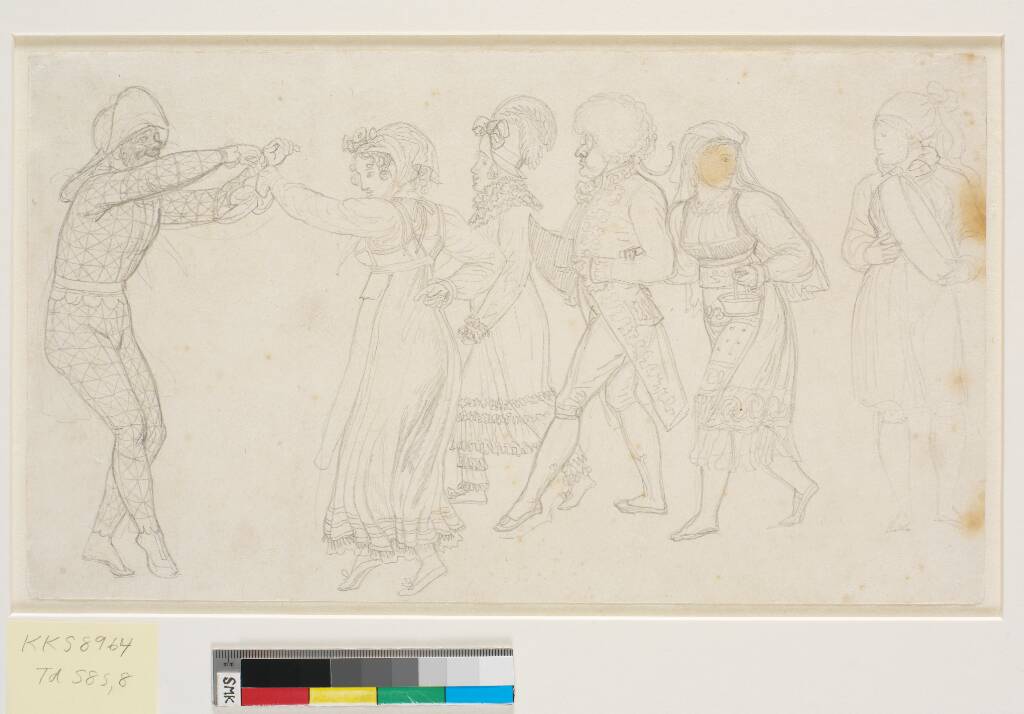
Title: Carnival Scene. Compositional drawing for The Carnival in Rome
Description not available.
Related Results
(XXIV) Peintures de la Sala Borgia au Vatican de l'invention de Raphael recueilles par les Piranesi et Dessinées par Thomas Piroli, Paris (Pietro and Francesco Piranesi and Leblanc) and Rome (Piroli) (1803); (XXV) Peintures de la Villa Lante, à Rome, de l
(XXIV) Peintures de la Sala Borgia au Vatican de l'invention de Raphael recueilles par les Piranesi et Dessinées par Thomas Piroli, Paris (Pietro and Francesco Piranesi and Leblanc) and Rome (Piroli) (1803); (XXV) Peintures de la Villa Lante, à Rome, de l
Engraving, (XXIV) Peintures de la Sala Borgia au Vatican de l'invention de Raphael recueilles par les Piranesi et Dessinées par Thomas Piroli Paris (Pietro and Francesco Piranesi ...
Nestoris (two-handled jar) with Mythological Scenes
Nestoris (two-handled jar) with Mythological Scenes
Red-figured Lucanian Type II nestoris. Broad ring foot with mid-length stem. Body flares from stem, rounds up, and turns in sharply to form a relatively narrow, flat shoulder. Neck...
Column Krater (mixing bowl for wine and water): Theseus and Poseidon; Musician and Audience
Column Krater (mixing bowl for wine and water): Theseus and Poseidon; Musician and Audience
On one side: the Athenian hero Theseus visits his divine father Poseidon. Theseus’s mother was Aethra, and ancient sources sometimes consider him to be the son of her husband, Aege...
Fan, a scene of merchants in Rome painted in watercolour on vellum, with patterned and painted cardboard box, Flemish, 1680-1720s. Fan with a scene of merchants in Rome, painted in watercolour on vellum.With cardboard box, covered with patterned paper and
Fan, a scene of merchants in Rome painted in watercolour on vellum, with patterned and painted cardboard box, Flemish, 1680-1720s. Fan with a scene of merchants in Rome, painted in watercolour on vellum.With cardboard box, covered with patterned paper and
Fan, a scene of merchants in Rome painted in watercolour on vellum, with patterned and painted cardboard box, Flemish, 1680-1720s. Fan with a scene of merchants in Rome, painted in...
Pastoral Landscape with the Flight into Egypt
Pastoral Landscape with the Flight into Egypt
Claude Lorraine, whose artistic inspiration derived from the Roman Campagna, can be considered one of the great figures of 17th-century classical landscape painting. He arrived in ...
The Medici vase, a large vase to right decorated with a representation of the sacrifice of Iphigenia, on a garden terrace, a teenage boy seated to left with a pen and paper with a drawing of the vase, cyprus trees and an obelisk to left in the background,
The Medici vase, a large vase to right decorated with a representation of the sacrifice of Iphigenia, on a garden terrace, a teenage boy seated to left with a pen and paper with a drawing of the vase, cyprus trees and an obelisk to left in the background,
Etching; second state of two, 'Six large views four of Rome and two of the Roman countryside' (Six grandes vues dont quatre de Rome et deux de la Campagne romaine)...
The goddess Calypso rescues Odysseus
The goddess Calypso rescues Odysseus
The subject is unusual and disputed. In Sluijter-Seiffert’s study of the artist, it is simply referred to as “Landscape with Nymph” and it has also been called “Scene from the scap...