
Search engine for discovering works of Art, research articles, and books related to Art and Culture


Javascript must be enabled to continue!
figur, skulptur, staty, statue, sculpture
View through Europeana Collections
1887.08.5172+5173. Function: For as long as we have known, people have come to Benares to be able to meet the gods, primarily Shiva, but also to die, be cremated and be released from reincarnation. The city is filled with temples and holy places where gods have manifested themselves, and where one can obtain an “audience”, darshana, with them. You meet their gaze and bring your offerings. In circles, the routes of pilgrimage in the city encompass everything, successively, from the holiest sanctum in the innermost temple to the whole region, which is called Kashi by the pilgrims. The central temple is dedicated to Shiva as “Ruler of the Universe”, Vishanatha. As in Stolpe’s time it is jammed in, in the dense bazaar settlement, neighbor to the Jnana Vapi mosque. As well as for Hindus, Benares is a holy city for Muslims, Sikhs, Jainists and Buddhists. Hjalmar Stolpe must have walked the narrow lanes of Benares when making his acquisitions. Just opposite the western entrance to the temple lie shops and workshops where statues of marble in black and green kinds of stone are hewn, chisellled, polished, often painted and offered to customers. The majority of the artisans as well as the raw material come from Rajasthan. Jaipur Murtiwala (“The statue makers of Jaipur”) are probably biggest in the business today and might have been the case also at the time of Stolpe’s visit. He bought a number of statues mostly in white painted marble. Among them was the pair of Krishna and Radha.
Acquisition Acquired by Hjalmar Stolpe during his circumnavigation on the ship Vanadis (which he had just left to be able to stay on longer in India). The huge Vanadis collections were first handled separately but were eventually to form one of the original major collections that made up the Ethnographic Museum.
Why this is a masterpiece
The objects may not be “masterpieces” in their own right, but have been chosen because of their meaning and usefulness to the museum.
History of the Object
The objects were fashioned in one of the workshops in old Benares/Varanasi, from which Hjalmar Stolpe acquired them. These shops offer anthropomorphic statues as well as non-anthropomorphic ones (linga for Shiva) which people buy and bring home for private chapels, village temples or temples of a more major kind. (Virtual Collection of Masterpieces, http://masterpieces.asemus.museum/Default.aspx)
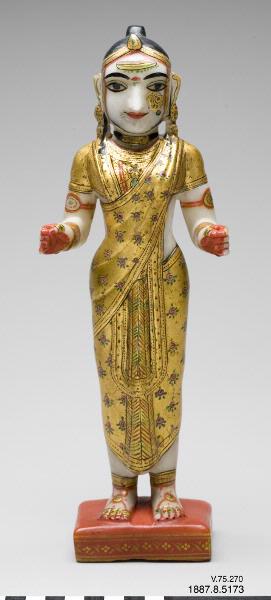
Title: figur, skulptur, staty, statue, sculpture
Description:
1887.
08.
5172+5173.
Function: For as long as we have known, people have come to Benares to be able to meet the gods, primarily Shiva, but also to die, be cremated and be released from reincarnation.
The city is filled with temples and holy places where gods have manifested themselves, and where one can obtain an “audience”, darshana, with them.
You meet their gaze and bring your offerings.
In circles, the routes of pilgrimage in the city encompass everything, successively, from the holiest sanctum in the innermost temple to the whole region, which is called Kashi by the pilgrims.
The central temple is dedicated to Shiva as “Ruler of the Universe”, Vishanatha.
As in Stolpe’s time it is jammed in, in the dense bazaar settlement, neighbor to the Jnana Vapi mosque.
As well as for Hindus, Benares is a holy city for Muslims, Sikhs, Jainists and Buddhists.
Hjalmar Stolpe must have walked the narrow lanes of Benares when making his acquisitions.
Just opposite the western entrance to the temple lie shops and workshops where statues of marble in black and green kinds of stone are hewn, chisellled, polished, often painted and offered to customers.
The majority of the artisans as well as the raw material come from Rajasthan.
Jaipur Murtiwala (“The statue makers of Jaipur”) are probably biggest in the business today and might have been the case also at the time of Stolpe’s visit.
He bought a number of statues mostly in white painted marble.
Among them was the pair of Krishna and Radha.
Acquisition Acquired by Hjalmar Stolpe during his circumnavigation on the ship Vanadis (which he had just left to be able to stay on longer in India).
The huge Vanadis collections were first handled separately but were eventually to form one of the original major collections that made up the Ethnographic Museum.
Why this is a masterpiece
The objects may not be “masterpieces” in their own right, but have been chosen because of their meaning and usefulness to the museum.
History of the Object
The objects were fashioned in one of the workshops in old Benares/Varanasi, from which Hjalmar Stolpe acquired them.
These shops offer anthropomorphic statues as well as non-anthropomorphic ones (linga for Shiva) which people buy and bring home for private chapels, village temples or temples of a more major kind.
(Virtual Collection of Masterpieces, http://masterpieces.
asemus.
museum/Default.
aspx).
Related Results
Standing Buddha Shakyamuni in Varada-mudra
Standing Buddha Shakyamuni in Varada-mudra
This sculpture depicts a Buddha gracefully standing on a shallow lotus pedestal, the Buddha likely the Buddha Sakyamuni (the Historical Buddha) though possibly the Buddha Dipankara...
figur, skulptur, snidad figur, sculpture, statue, figure, goam
figur, skulptur, snidad figur, sculpture, statue, figure, goam
The sculpture shows a male figure sitting with his legs pulled under him. He wears a tall, cylindrical headdress that narrows upwards. A snake winds on the front of the sculpture a...
skulptur, staty, figur, sculpture, statue
skulptur, staty, figur, sculpture, statue
1887.08.5172+5173. Function: For as long as we have known, people have come to Benares to be able to meet the gods, primarily Shiva, but also to die, be cremated and be released f...
Statue of the Cloister Mother Mary
Statue of the Cloister Mother Mary
3D model of a replica of the statue described below. Legend has it that the statue was found in a barn wall on the farm at Skriðuklaustur. Carved from oak, it is 71 cm tall and was...
figur, skulptur, sculpture
figur, skulptur, sculpture
Function: Statue of Vajrapani, a major Mahayana Bodhisattva, to be placed in a temple hall, preferably at its entrance since he is variously fierce and compassionate. He appears a...
Bearded Head of a Votary
Bearded Head of a Votary
This statue head, broken off at the neck, represents a bearded man wearing a conical hat. The eyes, indicated by shallow raised relief, are wide and flat. The wide nose is poorly p...
Head from a Statue of Ur-Ningirsu, Ruler of Lagash
Head from a Statue of Ur-Ningirsu, Ruler of Lagash
This stone statue, broken off below the neck, represents a man’s head. The eyes are almond-shaped and have thick lids. The eyebrows are also very thick, and meet on the bridge of t...