
Search engine for discovering works of Art, research articles, and books related to Art and Culture



Javascript must be enabled to continue!
A highly decorated oar given to the boatmen of Bednore by their Raja. August 15 1805
View through Europeana Collections
Pen and ink drawing of a elaborately decorated
oar given by the Rajas of Bednore and kept by the boatmen at
Shimoga. This drawing is taken from an album of 156 drawings (185
folios) chiefly of architecture and sculpture in S. India, dated
1803-08, from the MacKenzie Collection. Some drawings are by
MacKenzie himself, others by his assistant surveyors and draftsmen,
including H. Hamilton and J. Newman.The last quarter of the 17th
century and the first half of the 18th century were a period of
considerable instability in the history of Southern India with
continuos incursions from the north first by the Marathas, then the
Adil Shahis and Qutb Shahi and finally by the Mughal. In the second
half of the century much of the region was invaded by Haider Ali
and the French and British struggled for control of the 'Carnatic'.
In 1763, Bednore, now Haidarnagar, was invaded by Haider Ali, the
Sultan of Mysore, who had usurped the Mysore throne two years
earlier from the Wodeyar king, and the Keladi Nayaka dynasty fell.
He ruled for the next 19 years and was succeeded by his son, Tipu,
who ruled for the next 17 years. In 1782-83, during the Third
Mysore War, Bednore surrendered to the British
forces.
The British Library
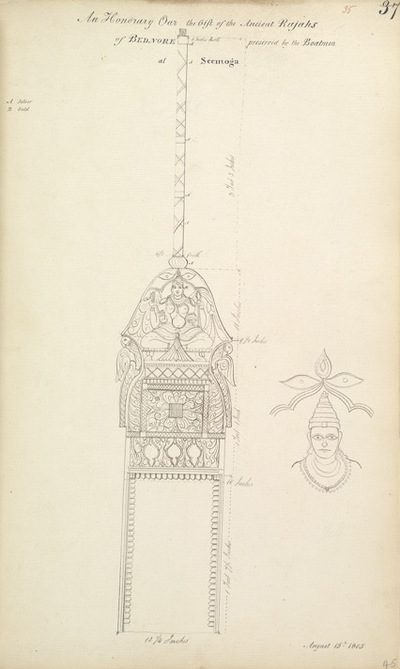
Title: A highly decorated oar given to the boatmen of Bednore by
their Raja. August 15 1805
Description:
Pen and ink drawing of a elaborately decorated
oar given by the Rajas of Bednore and kept by the boatmen at
Shimoga.
This drawing is taken from an album of 156 drawings (185
folios) chiefly of architecture and sculpture in S.
India, dated
1803-08, from the MacKenzie Collection.
Some drawings are by
MacKenzie himself, others by his assistant surveyors and draftsmen,
including H.
Hamilton and J.
Newman.
The last quarter of the 17th
century and the first half of the 18th century were a period of
considerable instability in the history of Southern India with
continuos incursions from the north first by the Marathas, then the
Adil Shahis and Qutb Shahi and finally by the Mughal.
In the second
half of the century much of the region was invaded by Haider Ali
and the French and British struggled for control of the 'Carnatic'.
In 1763, Bednore, now Haidarnagar, was invaded by Haider Ali, the
Sultan of Mysore, who had usurped the Mysore throne two years
earlier from the Wodeyar king, and the Keladi Nayaka dynasty fell.
He ruled for the next 19 years and was succeeded by his son, Tipu,
who ruled for the next 17 years.
In 1782-83, during the Third
Mysore War, Bednore surrendered to the British
forces.
Related Results
Tobacco pouch
Tobacco pouch
"362-22" "Two Bears Band, Fort Rice.″Yanktonai pipe bag; wool, glass, porcupine quills; l. 43.5/73 cm., w. 16.5 cm.; ca. 1860s.″Documentation: \Two Bears band, Fort Rice.‖ Purchase...
Ceremonial tobacco pouch
Ceremonial tobacco pouch
Pipe bag; Lakota; ca. 1870-1880 \nHide, glass beads, porcupine quills, pigments; l. 40 cm. (incl. fringe); w. 13 cm.\nRMV 3158-9; purchased from art dealer Leendert Van Lier, Amste...
Tobacco pouch
Tobacco pouch
Tobacco, smoking, ritual, pipes, tobacco bags Tobacco was a stimulant used by the indigenous people in large parts of North, Central and South America as a sedative, medicine again...
Booties for mannequin
Booties for mannequin
"(Western?) Apache moccasins for a doll; buckskin, sinew, glass beads; l. (of sole) 5 cm., h. 9 cm., w. 2.5 cm.; ca. 1880.\These beaded miniature high-top moccasins with toe tabs a...
Breechcloth
Breechcloth
Breechcloth; probably Yanktonai; 1860-1870Wool, porcupine quills, sinew, metal, horsehair, pigments; 117.5 x 28.5 cm.\RMV 710-9; Herman F.C. ten Kate collection; purchased from tra...