
Search engine for discovering works of Art, research articles, and books related to Art and Culture


Javascript must be enabled to continue!
stol, ceremonistol, skulptur, sculpture, ceremonial chair
View through Europeana Collections
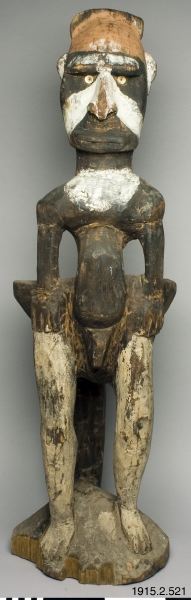
Chair of light brown wood with dark patina, cut from a piece of wood. At the bottom a round pedestal from which three legs rise towards the seater. Two of the legs make up the body of a man’s figure that funnel as a backrest on the chair. The figure is turned out of the chair. The figure has feet with four toes on each foot. Arms hanging down from the body with hands, each with four fingers. A large head with mouth cut in low relief, large pierced nose. Eyes made of seashells and clearly marked eyebrows. Outstanding ears and heads that end in a crosswise comb. The figure is painted with white legs, a crescent-shaped white painting on the chest, an upside down V from the nose root over the cheeks. A white dash in the forehead that passes to a red painting of the remaining forehead. White painted ears.
Chairs like this play an important ceremonial role in the Sepika area and mainly in Middle Sepik. They have never been used to sit on. They are usually placed at the middle pillar in the men’s ceremonial house and are the figurative representation of the most important village spirit. It also represents the spirit of the clan on whose land one built the men’s house. The chair has also had an important role in warfare, when profit or loss has been declared with the chair present or not present at the time of the war. Furthermore, the chair has an important role in political life. All cases concerning the village must be discussed with the presence of the chair. Whoever is to speak is standing his chair and holding a bundle of leaves in his hand. For every argument he puts forward, he puts a leaf on his chair to strength it. When finished, the leaves remain on his chair until the next speaker presents his ideas.
Title: stol, ceremonistol, skulptur, sculpture, ceremonial chair
Description:
Chair of light brown wood with dark patina, cut from a piece of wood.
At the bottom a round pedestal from which three legs rise towards the seater.
Two of the legs make up the body of a man’s figure that funnel as a backrest on the chair.
The figure is turned out of the chair.
The figure has feet with four toes on each foot.
Arms hanging down from the body with hands, each with four fingers.
A large head with mouth cut in low relief, large pierced nose.
Eyes made of seashells and clearly marked eyebrows.
Outstanding ears and heads that end in a crosswise comb.
The figure is painted with white legs, a crescent-shaped white painting on the chest, an upside down V from the nose root over the cheeks.
A white dash in the forehead that passes to a red painting of the remaining forehead.
White painted ears.
Chairs like this play an important ceremonial role in the Sepika area and mainly in Middle Sepik.
They have never been used to sit on.
They are usually placed at the middle pillar in the men’s ceremonial house and are the figurative representation of the most important village spirit.
It also represents the spirit of the clan on whose land one built the men’s house.
The chair has also had an important role in warfare, when profit or loss has been declared with the chair present or not present at the time of the war.
Furthermore, the chair has an important role in political life.
All cases concerning the village must be discussed with the presence of the chair.
Whoever is to speak is standing his chair and holding a bundle of leaves in his hand.
For every argument he puts forward, he puts a leaf on his chair to strength it.
When finished, the leaves remain on his chair until the next speaker presents his ideas.
Related Results
Standing Buddha Shakyamuni in Varada-mudra
Standing Buddha Shakyamuni in Varada-mudra
This sculpture depicts a Buddha gracefully standing on a shallow lotus pedestal, the Buddha likely the Buddha Sakyamuni (the Historical Buddha) though possibly the Buddha Dipankara...
The British Resident's Chair
The British Resident's Chair
The chair depicted on the page has a large pink seat and backing. The chair’s frame is white and is detailed with gold flower medallions and moulded leaves. On both arms are thick,...
Dance belt
Dance belt
674-3, 6°Kachina dance sash (in two halves); ta-kun-i-kwi-kya-tsi-napa, or kâkâthléom (TK); cotton, wool, pigments; l. 102 cm. (without fringe), w. 26.5 cm.; ca. 1880.‖ The oldest ...
Head of Buddha, probably the Buddha Sakyamuni
Head of Buddha, probably the Buddha Sakyamuni
Carved in gray limestone in Thailand in the seventh or early eighth century, this stone sculpture depicts the head of a Buddha, probably the Buddha Sakyamuni, the Historical Buddha...
Cloth for men
Cloth for men
A men's cloth (hinggi), consisting of two weaves sewn together. On the cloth are skull trees and horses. The central band shows the 'patola ratu' motif, a motif inspired by the pat...
Ceremonial wraparound skirt for women
Ceremonial wraparound skirt for women
The cloth is worn as a wraparound skirt by important Bushoong women during rituals and ceremonies. Often the cloth is wrapped with a band or belt around the top, over which the clo...
Dance belt
Dance belt
362-187Hopi woven belt, faja (TK); wool; l. 239 cm., w. 9 cm.; ca. 1880.\Such belts were usually used by women to secure their dress, but on ceremonial occasions men adopted these ...
Ceremonial tobacco pouch
Ceremonial tobacco pouch
Pipe bag; Lakota; ca. 1870-1880 \nHide, glass beads, porcupine quills, pigments; l. 40 cm. (incl. fringe); w. 13 cm.\nRMV 3158-9; purchased from art dealer Leendert Van Lier, Amste...