
Search engine for discovering works of Art, research articles, and books related to Art and Culture


Javascript must be enabled to continue!
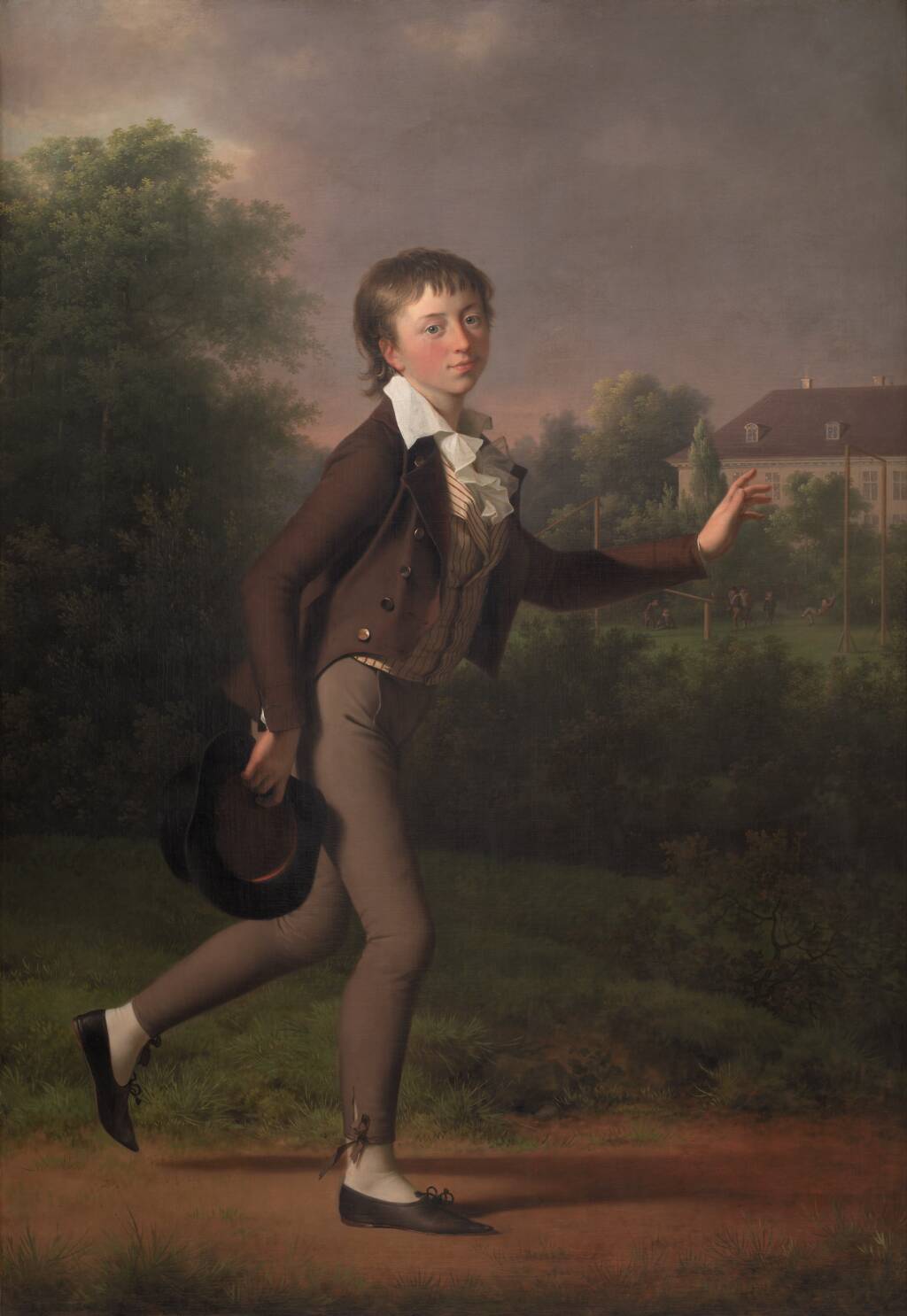
A Running Boy. Marcus Holst von Schmidten
View through National Gallery of Denmark
Here, Juel chose to depict a young nobleman dashing off to school.
The school in question was Christianis Institut, which focused greatly on movement and exercise and built Denmark’s first playground.
The young nobleman, Marcus Pauli Holst von Schmidten, is seen running on his way to school; his school is glimpsed in the background. The boy’s figure is simultaneously in movement and in balance. It is one of few examples of a figure in movement in Juel’s mature work. Like several other of Juel’s late works, this painting has a certain classical feel. It has prompted comparisons to the portraits created by his contemporary, the French artist Jacques Louis David, but there is no evidence proving that Juel had direct knowledge of David. It is, however, possible that Juel was introduced to English portraits through his friend, the engraver J. F. Clemens, who stayed in London 1792-95. An engraving after the American painter Gilbert Stuart's The Skater (Washington, National Gallery of Art) may have served as inspiration for this painting. The landscape does not surround the boy; it exclusively serves to form the background, thereby helping to give the painting a relief-like feel.
Juel’s decision to show the boy in movement is very deliberate; the boy attended the Christianis Institut school, which lay outside of the Copenhagen of the day (where the Vesterbro neighbourhood is today). The school did pioneering work to give children the opportunity to play and do athletics in the open air. The school’s playground was the first to be built in Denmark.
Title: A Running Boy. Marcus Holst von Schmidten
Description:
Here, Juel chose to depict a young nobleman dashing off to school.
The school in question was Christianis Institut, which focused greatly on movement and exercise and built Denmark’s first playground.
The young nobleman, Marcus Pauli Holst von Schmidten, is seen running on his way to school; his school is glimpsed in the background.
The boy’s figure is simultaneously in movement and in balance.
It is one of few examples of a figure in movement in Juel’s mature work.
Like several other of Juel’s late works, this painting has a certain classical feel.
It has prompted comparisons to the portraits created by his contemporary, the French artist Jacques Louis David, but there is no evidence proving that Juel had direct knowledge of David.
It is, however, possible that Juel was introduced to English portraits through his friend, the engraver J.
F.
Clemens, who stayed in London 1792-95.
An engraving after the American painter Gilbert Stuart's The Skater (Washington, National Gallery of Art) may have served as inspiration for this painting.
The landscape does not surround the boy; it exclusively serves to form the background, thereby helping to give the painting a relief-like feel.
Juel’s decision to show the boy in movement is very deliberate; the boy attended the Christianis Institut school, which lay outside of the Copenhagen of the day (where the Vesterbro neighbourhood is today).
The school did pioneering work to give children the opportunity to play and do athletics in the open air.
The school’s playground was the first to be built in Denmark.
Related Results
Wilhelm Kempe med anhöriga
Wilhelm Kempe med anhöriga
WILHELM KEMPE, JOHANNA KEMPE WALLIS, WALTHER VON HALLWYL, WILHELMINA VON HALLWYL KEMPE, EBBA VON HALLWYL, WILHELM VON ECKERMANN and ELLEN and IRMA VON HALLWYL, 1885. Photographs, e...
Kerchief, cotton embroidered with silk in double running stitch variations and with metal thread in satin stitch and double running in a line, trimmed with a lace-like edging, Crete; Turkey, 1800-1875. Kerchief, cotton embroidered with silk in double runn
Kerchief, cotton embroidered with silk in double running stitch variations and with metal thread in satin stitch and double running in a line, trimmed with a lace-like edging, Crete; Turkey, 1800-1875. Kerchief, cotton embroidered with silk in double runn
Kerchief, cotton embroidered with silk in double running stitch variations and with metal thread in satin stitch and double running in a line, trimmed with a lace-like edging, Cret...
Hunter elevator. Hunters with buffaloes, leopard and predatory cat in cage, drawn by horses, Duke Johann Georg zu Saxony, Joachim von Schulenburg, Caspar von Schwolentzki, Tobias von Thür (Dier?), Heinrich von Gunteradt (Günderrode), Hans Georg von Osterh
Hunter elevator. Hunters with buffaloes, leopard and predatory cat in cage, drawn by horses, Duke Johann Georg zu Saxony, Joachim von Schulenburg, Caspar von Schwolentzki, Tobias von Thür (Dier?), Heinrich von Gunteradt (Günderrode), Hans Georg von Osterh
Hunter elevator. Hunters with buffaloes, leopard and predatory cat in cage, drawn by horses, Duke Johann Georg zu Saxony, Joachim von Schulenburg, Caspar von Schwolentzki, Tobias v...
Table Plateau
Table Plateau
BORDSPLATY Consisting of a bottom plate (plateau) with a mirror glass, two flower bowls with artificial bouquets, two fruit bowls with glass bowls, six confectionery bowls with gla...
Boy in a Turban holding a Nosegay
Boy in a Turban holding a Nosegay
In addition to painting scenes of street life with picturesque characters inspired by his years in Rome, Sweerts also produced a few portraits as well as a series of half-length an...
Boy's coat and cap; English, 1930s. Boy's grey tweed coat and cap; Boy's tailored double-breasted coat of grey tweed lined with grey rayon. The coat has a turn-down collar with notched lapels, wrist-length sleeves, and inset pockets (with self fabric fla
Boy's coat and cap; English, 1930s. Boy's grey tweed coat and cap; Boy's tailored double-breasted coat of grey tweed lined with grey rayon. The coat has a turn-down collar with notched lapels, wrist-length sleeves, and inset pockets (with self fabric fla
Boy's coat and cap; English, 1930s. Boy's grey tweed coat and cap; Boy's tailored double-breasted coat of grey tweed lined with grey rayon. The coat has a turn-down collar with no...
Study of a Boy's Head
Study of a Boy's Head
Acquisition of the Month, September 2015 An Oil Study by Thomas Willeboirts Bosschaert Nationalmuseum’s collection of Baroque paintings has been enriched by a work by Flemish paint...