
Search engine for discovering works of Art, research articles, and books related to Art and Culture


Javascript must be enabled to continue!
Moccasins
View through Europeana Collections
CLOTHING AND ACCESSORIES: production and decoration The wealth of the Plains consisted of the immense bison herds. The bison didn't just provide food. The hide of this animal was used for tents, clothing, purses, horse harnesses, shields, knife blades, folding bags, etc. Before the bison skin could be processed into clothing etc., it had to be treated to make it supple and durable. The tanning was done in a mixture that included bone marrow, ground intestines and cactus juice. Deer hides were also popular for making clothing because of their light weight, light colour and supple character. Often women's clothing was made from them. After their pretreatment, the bison and deer skins were processed and decorated by painting and appliqué of porcupine quills and beads. This decorative art took off on the Plains and in regions adjacent to it.‖ The long pens of porcupine quills (Erethizon dorsatus), called quills, were popular materials for decorating garments. Although this animal occurred on only a small portion of the Plains, the pens were available throughout the Plains through intertribal trade. Only the Black Hills of South Dakota was home to the porcupine, and the Teton Dakota of this area used the pens most extensively to decorate their clothing and utensils. In times of scarcity, pens made from bird feathers, certain grass stalks, and strips of corn leaf and fern leaf were also used.‖ The pens were either flattened or not, after which they were boiled to make them pliable. During cooking, natural mineral and vegetable dyes were added to dye the pens. The color red was obtained from certain berries or the inner bark of the river urchin. Yellow was obtained from the petals of the sunflower, the buds of the poplar tree or the roots of the tannery tree. Some nuts produced a black dye. Iron oxide and tannin from plants worked as fixatives. The colour effect was enhanced by cutting off the ends of the pins to allow the paint to penetrate better into the pores and hollow pins. The colour palette expanded considerably when white traders introduced aniline paints in the late nineteenth century. This also involved boiling pens together with European or American fabrics, allowing the pens to take on the color of the textiles.‖ The flat painted pens were usually applied in geometric patterns to leather, especially garments such as shirts and moccasins. They were also used to decorate pipe pockets, bags, cradles and other utensils. The ends of the pins were often notched into the leather or attached with a thin bison twine. Stitches were camouflaged by folding the pin over them. A wrapping technique was also used to decorate leather fringes, tufts of hair and pipe stems. Sometimes the pins were interwoven before being fixed on leather. Geometrical patterns vary from stripes and bars to triangles and diamonds. Depending on the course of the stitches, patterns can also take more naturalistic forms. By combining wavy stitches and narrow bands, stylized images of mythological figures and people, later also animals and flowers, can be achieved.\ The penwork was a female occupation. The Tetons and Cheyennes even had separate societies for women who devoted themselves to this technique and were aware of the spiritual power of the decorative figures. The most experienced and therefore usually older woman was in charge, acting as a mentor and teacher. Inspiration for penwork patterns was often obtained in dreams, for Plains Indians a proof of their spiritual origin. Patterns that offered protection from calamity and adversity were especially valued, including the mythological thunderbirds and panthers. These were applied to baby cribs, warriors' clothing, etc. The quillwork was gradually supplanted after the introduction of western beads. Beads were initially made from shells and animal teeth and applied individually to clothing. They could also be sewn onto clothing unprocessed, which was especially done with cowrie shells and moose teeth on the tops of women's clothing. The beads of Venetian glass introduced in the sixteenth century were very expensive and were therefore of limited use. Nevertheless, they reached the Plains through inter-tribal trade. Beginning in the late eighteenth century, fur trading firms began to introduce large and inexpensive beads, often called China or Crow beads, as a means of exchange. After 1800 the somewhat smaller "pony bead" was available, opaque and still relatively large. After the introduction around 1840 of small glass beads, called seed beads, the latter quickly gained prominence. These beads came mainly from Bohemia, and to a lesser extent from France, Germany and the Netherlands. They were always available, cheap and in many colours and shades, which opened up new possibilities of aesthetic expression. In many tribes, porcupine quillwork was almost entirely supplanted by beadwork, and the patterns of early beadwork bear similarities to those of quillwork.Through the use of different stitches, it was possible to execute both straight and curved lines, geometric figures and naturalistic images in beadwork. With the lazy-stitch where a series of beads were strung together, applied and secured with the same thread, geometric figures were formed that could cover large areas. Geometric figures include lines, squares, rectangles and triangles. The hourglass motif is common and consists of a double triangle, one of which is the mirror image of the other. With the spot stitch. (also called overlay stitch) beads were strung together and a second thread was used to sew the beads together in a straight or curved line. This could be used to create circles, floral motifs and animal figures. Geometric motifs on the Plains are older than figurative pen and bead embellishments.‖ Patterns for beadwork were influenced in the nineteenth century in part by Indians seeing tapestries with Oriental motifs and copying some of them, with or without modifications. The floral style of beadwork, with its characteristic flower and leaf motifs, was developed in the early nineteenth century mainly by the Indian-white mixed population in the Red River area, the so-called Métis. These mestizos were mostly the offspring of mixed unions between white fur traders and Indian women, particularly from the Chippewa and Cree tribes, but also from other Algonkin tribes and Iroquois peoples from the Great Lakes region. The floral style spread from 1830 on through trade contacts over the area west of the Great Lakes as with the Santee Sioux and Assiniboin and the adjacent northern Plains where the Yanktonai were the trailblazers for the new style elements. Iowa, Oto, and Osage followed this trend, but were also influenced by the decorative styles of eastern tribes that were pushed further and further west by the advancing white settlers. Their beadwork is not only curvilinear, but also uses strongly contrasting colours and beads to fill the spaces between figures. The popularity of this style among the tribes of the eastern Plains has led to its designation as "Prairie Style". Some pre-Columbian curved and floral motifs are already found in the Ohio Valley and the Southeast. Floral motifs of European origin are found primarily in beadwork of women who attended white schools. Towards the end of the nineteenth century more naturalistic beadwork was produced in which images of people and animals were used. Some tribal styles developed of which the Crow style is the most recognizable because of the simple combined triangle and block motives, the simultaneous use of primary colors and pastel shades and the framing of patterns with several rows of mainly white but also other color beads to increase the color contrast. They also apply a stitch of their own, the Crow stitch, a variation of the spot stitch. This style was adopted by tribes from the adjoining Rocky Mountain region (Flathead, Nez Percé) and therefore referred to as "Transmontane".‖ Typical of women's clothing was the decoration of the upper part of leather dresses. Prior to the arrival of the whites, this was often dyed and decorated with horizontal rows of cowrie shells or moose teeth. When trade relations were established, the shells and teeth were applied to a ground of dark blue fabric, which made their pale color stand out more beautifully. Also, this part of the clothing, including sleeves, was often decorated with a "yoke," a contiguous panel of beads.* Colors, hues, and patterns had meaning depending on the tribe, family group, or even the maker. However, it is often difficult, if not impossible, in retrospect to unlock these meanings. A universally valid symbolism was lacking.‖ Beaded appliqué developed as a means of communicating social status. Women who mastered this technique well received a larger dowry than others who mastered this craft to a lesser degree. Material wealth enabled men to exempt their wives from some of their daily labour so that they could spend their time decorating clothing and utensils. These were then worn on occasions as an expression of status and prestige, both of the man and the woman.‖ What was true of the beaded decoration of clothing such as shirts, dresses, leggings and moccasins was also true of the beaded decoration of all sorts of accessories: belts, small and large bags, messchets, e.d.In 1883 Ten Kate visited an Ute reservation in Colorado and the Cheyenne and Arapahore reservations in Indian Territory, later Oklahoma). About the clothing of the Plains Indians, he made the following observations (1885:315,357-8): \"The (Ute) men still wear almost exclusively leather leggings of Indian manufacture and moccasins, while the upper body, on the other hand, is generally covered by an ordinary shirt and vest. The leggings of the Utes and the Indians in general differ from our trousers in that they only cover the legs, but not the abdomen or the posterior region either. They are fastened by means of bands, which are connected at the side to a band around the waist, as well as by a ghost ring, which runs between the legs. These leggings are usually beautifully decorated with colourful beads. ... As for the Utes' jewelry, it consists mainly of strings of beads, a kind of seashell plastrons, as well as silver and Berlin silver ear- and finger rings and bracelets. They buy the beads and seashells, as well as the objects made of Berlin silver, in the trader's store. ... The Utes get their silverware from the Navajos, their southwestern neighbours. ... As for the clothing of both tribes (Cheyennes and Arapahos), only the leggings and shoes are original. Leggings and moccasins are made of beautifully tanned soft leather, tastefully decorated with colourful, especially blue and white, beads; the leggings also sometimes have round Berlin silver plates. The men also generally wear trouser legs - because the rest of what belongs to a trouser is missing - of thick dark blue cloth with fluttering wide edges and entirely of Indian cut; furthermore they wear a covering, consisting of two blue woollen blankets sewn together, which not only forms a hood for the head, but is also large enough to envelope their entire figure. Often they drape themselves picturesquely in their blankets, as they once did their coats of bison skin...On the Plains, different style areas are distinguished on the basis of the most common traditional beaded patterns. On the Canadian part of the Plains and in the adjoining border area of the United States, the Northern-geometric style prevails, characterized by chequered patterns. These can be applied horizontally, vertically or diagonally. Connected triangular figures such as the hourglass motif are also characteristic, as well as horizontal bands. These motifs are mainly found on clothing and utensils of the Blackfoot, Assiniboin and Yanktonai. The central Plains style has several characteristics which may or may not occur simultaneously: large background areas set with white or blue beads, angular additions to geometric patterns, influenced by patterns on imitation Persian carpets. The northern Arapahos, northern Cheyennes and Tetons are representatives of this style. After 1885, more and more naturalistic bead images appeared on clothing and utensils, especially horses and warriors. The Crow beadwork style deviated somewhat, following the patterns characteristic of geometric parfleche painting. The southern Plains style was characteristic of the southern Arapahos, southern Cheyennes, Comanches, Kiowas, and Pawnees. Appliqué is usually limited to borders, hems, and narrow decorative stripes. Sometimes threads and beads are interwoven before being applied.The appliqué of beads almost completely supplanted pinwork. As a reimagining of traditional tribal cultures slowly began after World War II, it also manifested itself in the revival of quill work. However, this technique is extremely labor intensive, so it is usually applied to small areas: rosettes on clothing, jewelry, etc. Often, porcupine quills are also strung on a thread, then attached to leather, a less labor intensive method than traditional appliqué. Virtually only among the Sioux is there an unbroken continuity of pen work from prehistoric times. A few men have also applied themselves to it. Beadwork has always remained popular and was given a new impetus by the organization of powwows, parties where members of many Plains tribes gathered. Competition among women promoted quality. Exchange of ideas and experience led to the slow disappearance of typically tribal styles in beaded appliqué.Not only was appliqué applied to clothing, it was also painted. For this purpose, animal skins were first treated with animal and vegetable oils and juices. Women painted clothes with abstract geometric symbols. Elements that frequently occurred were a sun motif, concentric circles of stylized feathers and "box-and-border" patterns where the edges of the clothing are provided with a narrow border and in the middle of the clothing a rectangle is indicated with a geometric motif, sometimes repeating the motif of the border. This last pattern was often found on complete bison skins worn by women as coats. The feather motif was usually found on men's clothing.On clothing, shields and tent covers naturalistic figures of images obtained in visions were also applied. This was done predominantly by men. Healing and protective powers were attributed to these figures for the wearer of the clothing and the occupant of the tepee. Within the naturalistic direction are the pictographically stylized images of people and animals on clothing, loose skins and tent decks. The images are narrative and often tell events from the life of the wearer of the clothing: hunting scenes, war scenes, etc.One western introduction was ribbon appliqué on clothing. This technique was found especially on the southern Plains where Native American women came into contact not only with white women, but especially with the Indians who had been deported from the eastern United States to Oklahoma. These groups had been in contact with whites for some time and had learned the ribbon appliqué technique from them. Certain geometric patterns and stylized forms of plants are characteristic of Native American clothing that was decorated with colored ribbon. This form of decoration of clothing virtually supplanted pen work on the Southern Plains. Ribbon appliqué was actively practiced by the southern Siouans (Iowas, Osages, Omahas, Poncas, Otos, Kaws) and Caddoans (Caddos, Pawnees, Wichitas).\n(PH, 2000)\Mocassins are shoes made of leather that were worn by virtually all Indian tribes in North America, young and old. The shoes were made by the women. After introduction of western shoes and boots, moccasins were made to be worn during celebrations on the reservation. Indians also donated moccasins to white neighbors and friends as a token of goodwill and appreciation. Moccasins were also popular for a time as slippers and were made in large quantities to meet demand. Later, tourists often took moccasins as souvenirs of their travels across America or Canada, in memory of Indians they had met there. In recent years, miniature moccasins or baby moccasins have been very popular.™ Most moccasins are made from soft tanned leather. Beginning in the mid-19th century, some Plains tribes (including Sioux, Cheyennes) sewed a sole of hard untanned leather under the soft sole. A little later, two-piece moccasins were made with a hard sole and soft upper. Sometimes moccasins have a dropped collar decorated with beads and/or colored fabric (red, blue; Northeastern), or a collar of leather fringe. Other moccasins have a high collar that is wrapped over the ankles with a leather cord to provide extra protection from cold and thorny bushes. On the Southern Plains and in the Southwest, women sometimes attached leggings ("leggings") to moccasins, creating "women's boots" or "leg moccasins. "Moccasins for everyday use were usually unadorned. The earliest moccasins were given decorations by stitching on dyed porcupine quills. The introduction of colored glass beads by white merchants quickly superseded the time-consuming pen work. From about 1890 onward, beadwork was sometimes applied to the soles of moccasins, especially those intended as gifts or worn during festivities (Assiniboins, Teton Dakotas, Cheyenne). Tribes of the southern Plains (Comanches, Kiowa-Apaches) and the Southwest (Apaches) partially dyed their moccasins. The Apaches sometimes attached metal ferrules to the leather fringe of moccasins.‖ Leather moccasins, embroidered with light blue beads, anklets with black and green beads executed, and provided with some geometric motifs of red, black, green, and yellow beads. Such moccasins are made especially for powwows (dance parties), but also for tourists.
Title: Moccasins
Description:
CLOTHING AND ACCESSORIES: production and decoration The wealth of the Plains consisted of the immense bison herds.
The bison didn't just provide food.
The hide of this animal was used for tents, clothing, purses, horse harnesses, shields, knife blades, folding bags, etc.
Before the bison skin could be processed into clothing etc.
, it had to be treated to make it supple and durable.
The tanning was done in a mixture that included bone marrow, ground intestines and cactus juice.
Deer hides were also popular for making clothing because of their light weight, light colour and supple character.
Often women's clothing was made from them.
After their pretreatment, the bison and deer skins were processed and decorated by painting and appliqué of porcupine quills and beads.
This decorative art took off on the Plains and in regions adjacent to it.
‖ The long pens of porcupine quills (Erethizon dorsatus), called quills, were popular materials for decorating garments.
Although this animal occurred on only a small portion of the Plains, the pens were available throughout the Plains through intertribal trade.
Only the Black Hills of South Dakota was home to the porcupine, and the Teton Dakota of this area used the pens most extensively to decorate their clothing and utensils.
In times of scarcity, pens made from bird feathers, certain grass stalks, and strips of corn leaf and fern leaf were also used.
‖ The pens were either flattened or not, after which they were boiled to make them pliable.
During cooking, natural mineral and vegetable dyes were added to dye the pens.
The color red was obtained from certain berries or the inner bark of the river urchin.
Yellow was obtained from the petals of the sunflower, the buds of the poplar tree or the roots of the tannery tree.
Some nuts produced a black dye.
Iron oxide and tannin from plants worked as fixatives.
The colour effect was enhanced by cutting off the ends of the pins to allow the paint to penetrate better into the pores and hollow pins.
The colour palette expanded considerably when white traders introduced aniline paints in the late nineteenth century.
This also involved boiling pens together with European or American fabrics, allowing the pens to take on the color of the textiles.
‖ The flat painted pens were usually applied in geometric patterns to leather, especially garments such as shirts and moccasins.
They were also used to decorate pipe pockets, bags, cradles and other utensils.
The ends of the pins were often notched into the leather or attached with a thin bison twine.
Stitches were camouflaged by folding the pin over them.
A wrapping technique was also used to decorate leather fringes, tufts of hair and pipe stems.
Sometimes the pins were interwoven before being fixed on leather.
Geometrical patterns vary from stripes and bars to triangles and diamonds.
Depending on the course of the stitches, patterns can also take more naturalistic forms.
By combining wavy stitches and narrow bands, stylized images of mythological figures and people, later also animals and flowers, can be achieved.
\ The penwork was a female occupation.
The Tetons and Cheyennes even had separate societies for women who devoted themselves to this technique and were aware of the spiritual power of the decorative figures.
The most experienced and therefore usually older woman was in charge, acting as a mentor and teacher.
Inspiration for penwork patterns was often obtained in dreams, for Plains Indians a proof of their spiritual origin.
Patterns that offered protection from calamity and adversity were especially valued, including the mythological thunderbirds and panthers.
These were applied to baby cribs, warriors' clothing, etc.
The quillwork was gradually supplanted after the introduction of western beads.
Beads were initially made from shells and animal teeth and applied individually to clothing.
They could also be sewn onto clothing unprocessed, which was especially done with cowrie shells and moose teeth on the tops of women's clothing.
The beads of Venetian glass introduced in the sixteenth century were very expensive and were therefore of limited use.
Nevertheless, they reached the Plains through inter-tribal trade.
Beginning in the late eighteenth century, fur trading firms began to introduce large and inexpensive beads, often called China or Crow beads, as a means of exchange.
After 1800 the somewhat smaller "pony bead" was available, opaque and still relatively large.
After the introduction around 1840 of small glass beads, called seed beads, the latter quickly gained prominence.
These beads came mainly from Bohemia, and to a lesser extent from France, Germany and the Netherlands.
They were always available, cheap and in many colours and shades, which opened up new possibilities of aesthetic expression.
In many tribes, porcupine quillwork was almost entirely supplanted by beadwork, and the patterns of early beadwork bear similarities to those of quillwork.
Through the use of different stitches, it was possible to execute both straight and curved lines, geometric figures and naturalistic images in beadwork.
With the lazy-stitch where a series of beads were strung together, applied and secured with the same thread, geometric figures were formed that could cover large areas.
Geometric figures include lines, squares, rectangles and triangles.
The hourglass motif is common and consists of a double triangle, one of which is the mirror image of the other.
With the spot stitch.
(also called overlay stitch) beads were strung together and a second thread was used to sew the beads together in a straight or curved line.
This could be used to create circles, floral motifs and animal figures.
Geometric motifs on the Plains are older than figurative pen and bead embellishments.
‖ Patterns for beadwork were influenced in the nineteenth century in part by Indians seeing tapestries with Oriental motifs and copying some of them, with or without modifications.
The floral style of beadwork, with its characteristic flower and leaf motifs, was developed in the early nineteenth century mainly by the Indian-white mixed population in the Red River area, the so-called Métis.
These mestizos were mostly the offspring of mixed unions between white fur traders and Indian women, particularly from the Chippewa and Cree tribes, but also from other Algonkin tribes and Iroquois peoples from the Great Lakes region.
The floral style spread from 1830 on through trade contacts over the area west of the Great Lakes as with the Santee Sioux and Assiniboin and the adjacent northern Plains where the Yanktonai were the trailblazers for the new style elements.
Iowa, Oto, and Osage followed this trend, but were also influenced by the decorative styles of eastern tribes that were pushed further and further west by the advancing white settlers.
Their beadwork is not only curvilinear, but also uses strongly contrasting colours and beads to fill the spaces between figures.
The popularity of this style among the tribes of the eastern Plains has led to its designation as "Prairie Style".
Some pre-Columbian curved and floral motifs are already found in the Ohio Valley and the Southeast.
Floral motifs of European origin are found primarily in beadwork of women who attended white schools.
Towards the end of the nineteenth century more naturalistic beadwork was produced in which images of people and animals were used.
Some tribal styles developed of which the Crow style is the most recognizable because of the simple combined triangle and block motives, the simultaneous use of primary colors and pastel shades and the framing of patterns with several rows of mainly white but also other color beads to increase the color contrast.
They also apply a stitch of their own, the Crow stitch, a variation of the spot stitch.
This style was adopted by tribes from the adjoining Rocky Mountain region (Flathead, Nez Percé) and therefore referred to as "Transmontane".
‖ Typical of women's clothing was the decoration of the upper part of leather dresses.
Prior to the arrival of the whites, this was often dyed and decorated with horizontal rows of cowrie shells or moose teeth.
When trade relations were established, the shells and teeth were applied to a ground of dark blue fabric, which made their pale color stand out more beautifully.
Also, this part of the clothing, including sleeves, was often decorated with a "yoke," a contiguous panel of beads.
* Colors, hues, and patterns had meaning depending on the tribe, family group, or even the maker.
However, it is often difficult, if not impossible, in retrospect to unlock these meanings.
A universally valid symbolism was lacking.
‖ Beaded appliqué developed as a means of communicating social status.
Women who mastered this technique well received a larger dowry than others who mastered this craft to a lesser degree.
Material wealth enabled men to exempt their wives from some of their daily labour so that they could spend their time decorating clothing and utensils.
These were then worn on occasions as an expression of status and prestige, both of the man and the woman.
‖ What was true of the beaded decoration of clothing such as shirts, dresses, leggings and moccasins was also true of the beaded decoration of all sorts of accessories: belts, small and large bags, messchets, e.
d.
In 1883 Ten Kate visited an Ute reservation in Colorado and the Cheyenne and Arapahore reservations in Indian Territory, later Oklahoma).
About the clothing of the Plains Indians, he made the following observations (1885:315,357-8): \"The (Ute) men still wear almost exclusively leather leggings of Indian manufacture and moccasins, while the upper body, on the other hand, is generally covered by an ordinary shirt and vest.
The leggings of the Utes and the Indians in general differ from our trousers in that they only cover the legs, but not the abdomen or the posterior region either.
They are fastened by means of bands, which are connected at the side to a band around the waist, as well as by a ghost ring, which runs between the legs.
These leggings are usually beautifully decorated with colourful beads.
.
As for the Utes' jewelry, it consists mainly of strings of beads, a kind of seashell plastrons, as well as silver and Berlin silver ear- and finger rings and bracelets.
They buy the beads and seashells, as well as the objects made of Berlin silver, in the trader's store.
.
The Utes get their silverware from the Navajos, their southwestern neighbours.
.
As for the clothing of both tribes (Cheyennes and Arapahos), only the leggings and shoes are original.
Leggings and moccasins are made of beautifully tanned soft leather, tastefully decorated with colourful, especially blue and white, beads; the leggings also sometimes have round Berlin silver plates.
The men also generally wear trouser legs - because the rest of what belongs to a trouser is missing - of thick dark blue cloth with fluttering wide edges and entirely of Indian cut; furthermore they wear a covering, consisting of two blue woollen blankets sewn together, which not only forms a hood for the head, but is also large enough to envelope their entire figure.
Often they drape themselves picturesquely in their blankets, as they once did their coats of bison skin.
On the Plains, different style areas are distinguished on the basis of the most common traditional beaded patterns.
On the Canadian part of the Plains and in the adjoining border area of the United States, the Northern-geometric style prevails, characterized by chequered patterns.
These can be applied horizontally, vertically or diagonally.
Connected triangular figures such as the hourglass motif are also characteristic, as well as horizontal bands.
These motifs are mainly found on clothing and utensils of the Blackfoot, Assiniboin and Yanktonai.
The central Plains style has several characteristics which may or may not occur simultaneously: large background areas set with white or blue beads, angular additions to geometric patterns, influenced by patterns on imitation Persian carpets.
The northern Arapahos, northern Cheyennes and Tetons are representatives of this style.
After 1885, more and more naturalistic bead images appeared on clothing and utensils, especially horses and warriors.
The Crow beadwork style deviated somewhat, following the patterns characteristic of geometric parfleche painting.
The southern Plains style was characteristic of the southern Arapahos, southern Cheyennes, Comanches, Kiowas, and Pawnees.
Appliqué is usually limited to borders, hems, and narrow decorative stripes.
Sometimes threads and beads are interwoven before being applied.
The appliqué of beads almost completely supplanted pinwork.
As a reimagining of traditional tribal cultures slowly began after World War II, it also manifested itself in the revival of quill work.
However, this technique is extremely labor intensive, so it is usually applied to small areas: rosettes on clothing, jewelry, etc.
Often, porcupine quills are also strung on a thread, then attached to leather, a less labor intensive method than traditional appliqué.
Virtually only among the Sioux is there an unbroken continuity of pen work from prehistoric times.
A few men have also applied themselves to it.
Beadwork has always remained popular and was given a new impetus by the organization of powwows, parties where members of many Plains tribes gathered.
Competition among women promoted quality.
Exchange of ideas and experience led to the slow disappearance of typically tribal styles in beaded appliqué.
Not only was appliqué applied to clothing, it was also painted.
For this purpose, animal skins were first treated with animal and vegetable oils and juices.
Women painted clothes with abstract geometric symbols.
Elements that frequently occurred were a sun motif, concentric circles of stylized feathers and "box-and-border" patterns where the edges of the clothing are provided with a narrow border and in the middle of the clothing a rectangle is indicated with a geometric motif, sometimes repeating the motif of the border.
This last pattern was often found on complete bison skins worn by women as coats.
The feather motif was usually found on men's clothing.
On clothing, shields and tent covers naturalistic figures of images obtained in visions were also applied.
This was done predominantly by men.
Healing and protective powers were attributed to these figures for the wearer of the clothing and the occupant of the tepee.
Within the naturalistic direction are the pictographically stylized images of people and animals on clothing, loose skins and tent decks.
The images are narrative and often tell events from the life of the wearer of the clothing: hunting scenes, war scenes, etc.
One western introduction was ribbon appliqué on clothing.
This technique was found especially on the southern Plains where Native American women came into contact not only with white women, but especially with the Indians who had been deported from the eastern United States to Oklahoma.
These groups had been in contact with whites for some time and had learned the ribbon appliqué technique from them.
Certain geometric patterns and stylized forms of plants are characteristic of Native American clothing that was decorated with colored ribbon.
This form of decoration of clothing virtually supplanted pen work on the Southern Plains.
Ribbon appliqué was actively practiced by the southern Siouans (Iowas, Osages, Omahas, Poncas, Otos, Kaws) and Caddoans (Caddos, Pawnees, Wichitas).
\n(PH, 2000)\Mocassins are shoes made of leather that were worn by virtually all Indian tribes in North America, young and old.
The shoes were made by the women.
After introduction of western shoes and boots, moccasins were made to be worn during celebrations on the reservation.
Indians also donated moccasins to white neighbors and friends as a token of goodwill and appreciation.
Moccasins were also popular for a time as slippers and were made in large quantities to meet demand.
Later, tourists often took moccasins as souvenirs of their travels across America or Canada, in memory of Indians they had met there.
In recent years, miniature moccasins or baby moccasins have been very popular.
™ Most moccasins are made from soft tanned leather.
Beginning in the mid-19th century, some Plains tribes (including Sioux, Cheyennes) sewed a sole of hard untanned leather under the soft sole.
A little later, two-piece moccasins were made with a hard sole and soft upper.
Sometimes moccasins have a dropped collar decorated with beads and/or colored fabric (red, blue; Northeastern), or a collar of leather fringe.
Other moccasins have a high collar that is wrapped over the ankles with a leather cord to provide extra protection from cold and thorny bushes.
On the Southern Plains and in the Southwest, women sometimes attached leggings ("leggings") to moccasins, creating "women's boots" or "leg moccasins.
"Moccasins for everyday use were usually unadorned.
The earliest moccasins were given decorations by stitching on dyed porcupine quills.
The introduction of colored glass beads by white merchants quickly superseded the time-consuming pen work.
From about 1890 onward, beadwork was sometimes applied to the soles of moccasins, especially those intended as gifts or worn during festivities (Assiniboins, Teton Dakotas, Cheyenne).
Tribes of the southern Plains (Comanches, Kiowa-Apaches) and the Southwest (Apaches) partially dyed their moccasins.
The Apaches sometimes attached metal ferrules to the leather fringe of moccasins.
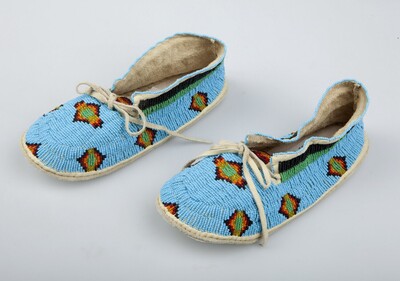
‖ Leather moccasins, embroidered with light blue beads, anklets with black and green beads executed, and provided with some geometric motifs of red, black, green, and yellow beads.
Such moccasins are made especially for powwows (dance parties), but also for tourists.
Related Results
Booties for mannequin
Booties for mannequin
"(Western?) Apache moccasins for a doll; buckskin, sinew, glass beads; l. (of sole) 5 cm., h. 9 cm., w. 2.5 cm.; ca. 1880.\These beaded miniature high-top moccasins with toe tabs a...
Babymoccasins
Babymoccasins
CLOTHING AND ACCESSORIES: production and decoration The wealth of the Plains consisted of the immense bison herds. The bison didn't just provide food. The hide of this animal was u...
Man's shirt
Man's shirt
Man's outfit; Plains Cree; 1840-1850Hide, porcupine quills, beaver toes, sinew, pigments; l. of shirt at front, 105 cm; l. of inside leggings, 115 cm.‖RMV 524-2 and 3; purchased fr...