
Search engine for discovering works of Art, research articles, and books related to Art and Culture


Javascript must be enabled to continue!
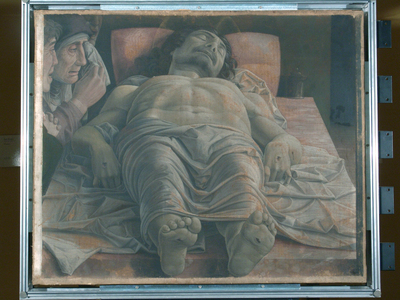
Christ dead in the sepulchre and three pains
View through Europeana Collections
The most convincing hypothesis, despite the uncertainties stemming from the existence of several variants of the same subject, identifies the painting in Brera with the “foreshortened Christ” found in Mantegna’s studio at the time of his death, sold by his son Ludovico to Cardinal Sigismondo Gonzaga and inventoried among the property of the lords of Mantua in 1627. The subsequent fate of the painting is still a matter of debate among scholars, faced with a complicated series of changes of ownership only partially – and confusedly – documented: according to the most recent but not conclusive theory, the painting was sold in 1628 to Charles I of England along with the most valuable pieces in the Gonzaga collection; it then passed onto the antique market and into the collection of Cardinal Mazarin; on the latter’s dispersal it vanished for over a century. No more was heard of it until the beginning of the 19th century: in 1806, in fact, the secretary of the Accademia di Brera Giuseppe Bossi asked the sculptor Antonio Canova to act as a go-between in the purchase of his “sought-after Mantegna,” which finally made its way into the Pinacoteca in 1824. The iconography of the work, probably intended for the artist’s private devotion, refers to the compositional scheme of the Lamentation over the Dead Christ, in which mourners are gathered around the body prepared for burial, laid out on the stone of unction and already anointed with perfumes. The composition produces a great emotional impact, accentuated by the extreme foreshortening: Christ’s body is very close to the viewpoint of the observer who, looking at it, is drawn into the center of the drama; moreover, every detail is enhanced by the incisiveness of the lines, which compels the gaze to linger over the most terrible details, over the members stiffened in rigor mortis as well as the wounds, ostentatiously presented in the foreground as called for by the tradition of this type of image. It is an absolute peak in Mantegna’s production, a work whose expressive force, severe composure and masterly handling of the illusion of perspective have made it one of the best-known symbols of the Italian Renaissance.
Brera Art Gallery
Title: Christ dead in the sepulchre and three pains
Description:
The most convincing hypothesis, despite the uncertainties stemming from the existence of several variants of the same subject, identifies the painting in Brera with the “foreshortened Christ” found in Mantegna’s studio at the time of his death, sold by his son Ludovico to Cardinal Sigismondo Gonzaga and inventoried among the property of the lords of Mantua in 1627.
The subsequent fate of the painting is still a matter of debate among scholars, faced with a complicated series of changes of ownership only partially – and confusedly – documented: according to the most recent but not conclusive theory, the painting was sold in 1628 to Charles I of England along with the most valuable pieces in the Gonzaga collection; it then passed onto the antique market and into the collection of Cardinal Mazarin; on the latter’s dispersal it vanished for over a century.
No more was heard of it until the beginning of the 19th century: in 1806, in fact, the secretary of the Accademia di Brera Giuseppe Bossi asked the sculptor Antonio Canova to act as a go-between in the purchase of his “sought-after Mantegna,” which finally made its way into the Pinacoteca in 1824.
The iconography of the work, probably intended for the artist’s private devotion, refers to the compositional scheme of the Lamentation over the Dead Christ, in which mourners are gathered around the body prepared for burial, laid out on the stone of unction and already anointed with perfumes.
The composition produces a great emotional impact, accentuated by the extreme foreshortening: Christ’s body is very close to the viewpoint of the observer who, looking at it, is drawn into the center of the drama; moreover, every detail is enhanced by the incisiveness of the lines, which compels the gaze to linger over the most terrible details, over the members stiffened in rigor mortis as well as the wounds, ostentatiously presented in the foreground as called for by the tradition of this type of image.
It is an absolute peak in Mantegna’s production, a work whose expressive force, severe composure and masterly handling of the illusion of perspective have made it one of the best-known symbols of the Italian Renaissance.
Related Results
Μουσείο Ιεράς Μονής Κύκκου (Κύπρος): Παράσταση της Σταύρωσης και τμήμα της Αποκαθήλωσης του Χριστού. Αποτοιχισμένη τοιχογραφία από το ναό του Αγίου Αντωνίου, Κελλιά, Λάρνακα, 13ος αιώνας (E 808)
Μουσείο Ιεράς Μονής Κύκκου (Κύπρος): Παράσταση της Σταύρωσης και τμήμα της Αποκαθήλωσης του Χριστού. Αποτοιχισμένη τοιχογραφία από το ναό του Αγίου Αντωνίου, Κελλιά, Λάρνακα, 13ος αιώνας (E 808)
Mural painting with Crucifixion and Deposition of Christ . The mural has been removed from the church of Saint Anthony at Kellia in Larnaca, Cyprus....
The Risen Christ
The Risen Christ
This panel depicting The Risen Christ was formerly in the collection of the Pusterla della Porta family in Milan, where it is recorded from 1590 until the first quarter of the 20th...
Christ with the Cross
Christ with the Cross
Christ holding the cross was a motif that El Greco derived from the narrative of Christ’s Passion, creating an isolated image that seems to have been extremely popular with his cli...
Diptych with symbols of the Virgin and Redeeming Christ: Christ with the Cross as Redemptor Mundi (Right wing)
Diptych with symbols of the Virgin and Redeeming Christ: Christ with the Cross as Redemptor Mundi (Right wing)
This pair of panels formed part of a large ensemble of which the other subjects are now unknown. Within the Museum’s collection they are among the most iconographically interesting...
Christ and the Woman of Samaria at the Well
Christ and the Woman of Samaria at the Well
The meeting between Christ and the woman of Samaria at the well is only recounted in the Gospel of Saint John. Christ, travelling to Galilee, reached the Samarian city of Sychar. W...
Diptych with symbols of the Virgin and Redeeming Christ: Virgin and Child in the Hortus Conclusus (Left wing)
Diptych with symbols of the Virgin and Redeeming Christ: Virgin and Child in the Hortus Conclusus (Left wing)
This pair of panels formed part of a large ensemble of which the other subjects are now unknown. Within the Museum’s collection they are among the most iconographically interesting...