
Search engine for discovering works of Art, research articles, and books related to Art and Culture


Javascript must be enabled to continue!
The Prodigal Son Living with Harlots
View through National Gallery of Denmark
In Baumgartners painting depicting the biblical tale, the Prodigal Son does not yet know that he is lost. Engrossed with the charms of women, wine, and music he pays no heed to the dark side of debauchery.
In his small oil painting depicting the biblical tale about the prodigal son Baumgartner not only used the rocaille as a frame, but as a motif in itself. The rocaille, a type of ornament typical of the Rococo, winds its way into the architectural setting of the scene, dissolving stone niches and intermingling with the food of the balustrade. As a child of the waves, sister to the seashell and twin to the corals the rocaille feels right at home within Baumgartner’s pastel-hued universe where the prodigal son does not yet know that he is lost. Engrossed with the charms of women, wine, and music he pays no heed to the dark side of debauchery.
Johann Wolfgang Baumgartner’s career was nothing if not versatile. First he was apprenticed as a blacksmith, then as a glass painter and a muralist. Posterity knows him as a creator of large-scale decorative work for churches where frescoes merge seamlessly with the Rococo architecture of the altarpieces. Baumgartner was also a prolific supplier of drawn and painted images for the major printmakers in the city of Augsburg. These printmakers issued many series depicting edifying biblical tales such The Prodigal Son, or calendars featuring some of the countless martyrs of Christianity.
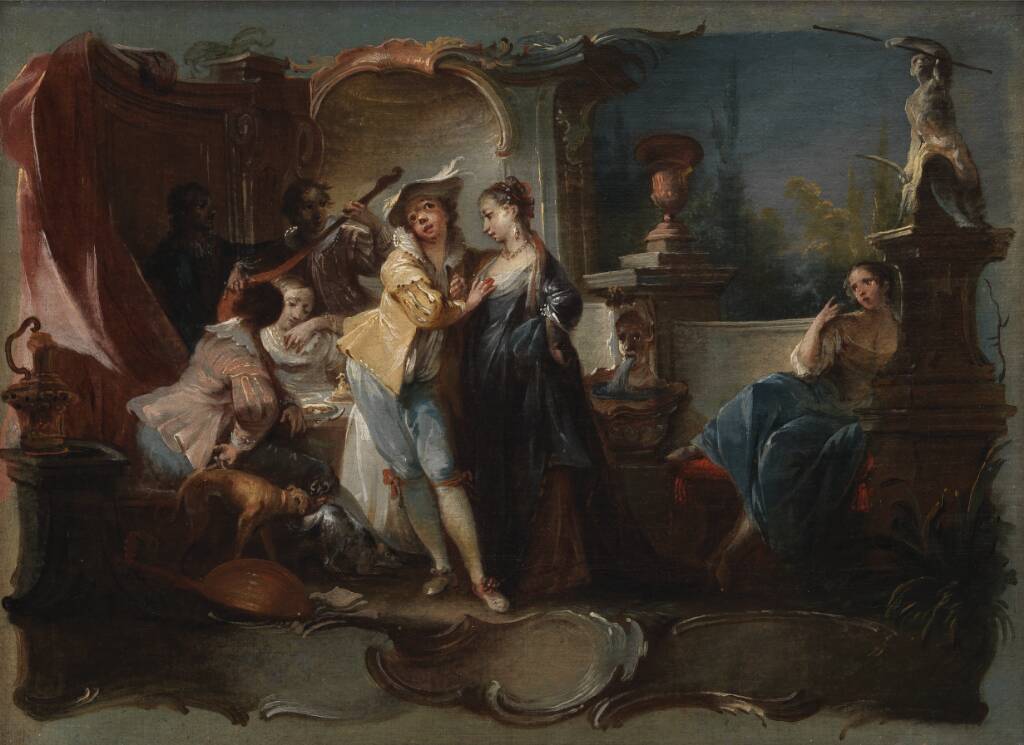
Title: The Prodigal Son Living with Harlots
Description:
In Baumgartners painting depicting the biblical tale, the Prodigal Son does not yet know that he is lost.
Engrossed with the charms of women, wine, and music he pays no heed to the dark side of debauchery.
In his small oil painting depicting the biblical tale about the prodigal son Baumgartner not only used the rocaille as a frame, but as a motif in itself.
The rocaille, a type of ornament typical of the Rococo, winds its way into the architectural setting of the scene, dissolving stone niches and intermingling with the food of the balustrade.
As a child of the waves, sister to the seashell and twin to the corals the rocaille feels right at home within Baumgartner’s pastel-hued universe where the prodigal son does not yet know that he is lost.
Engrossed with the charms of women, wine, and music he pays no heed to the dark side of debauchery.
Johann Wolfgang Baumgartner’s career was nothing if not versatile.
First he was apprenticed as a blacksmith, then as a glass painter and a muralist.
Posterity knows him as a creator of large-scale decorative work for churches where frescoes merge seamlessly with the Rococo architecture of the altarpieces.
Baumgartner was also a prolific supplier of drawn and painted images for the major printmakers in the city of Augsburg.
These printmakers issued many series depicting edifying biblical tales such The Prodigal Son, or calendars featuring some of the countless martyrs of Christianity.
Related Results
Prodigal Son Chased Away by Women
Prodigal Son Chased Away by Women
This tapestry depicts an episode from the parable of the prodigal son (Luke 15:11-32), and belongs to a series of this subject. After receiving his inheritance, the son left his fa...
The Prodigal Son Wasting his Fortune, from "The History of the Prodigal Son"
The Prodigal Son Wasting his Fortune, from "The History of the Prodigal Son"
Engraving; fifth of five states, The History of the Prodigal Son...
Departure of the Prodigal Son, from "The History of the Prodigal Son"
Departure of the Prodigal Son, from "The History of the Prodigal Son"
Engraving; fifth of five states (possibly a copy), The History of the Prodigal Son...
Prodigal Son Wasting his Fortune, from "The History of the Prodigal Son"
Prodigal Son Wasting his Fortune, from "The History of the Prodigal Son"
Engraving; fourth of five states, The History of the Prodigal Son...
The Prodigal Son Leaves Home
The Prodigal Son Leaves Home
Etching, The Prodigal Son
(L'Histoire de l'enfant prodigue)...
The Prodigal Son Leaves Home
The Prodigal Son Leaves Home
Etching, The Prodigal Son
(Histoire de l'Enfant prodigue)...