
Search engine for discovering works of Art, research articles, and books related to Art and Culture


Javascript must be enabled to continue!
Joan Miró: Pochoir
View through Artsy
In the 1930s, [Joan Miró](https://www.artsy.net/artist/joan-miro) began experimenting with the pochoir (French for “stencil”) printmaking technique to create Surrealist works on paper. Unlike the artist’s other favorite printmaking methods, [etching](https://www.artsy.net/collection/joan-miro-etchings) and [lithography](https://www.artsy.net/collection/joan-miro-lithographs), pochoir enabled him to create prints that most closely resembled his colorful gouache paintings. To create pochoir prints, Miró worked with master printmakers (including the renowned pochoir-expert Daniel Jacomet) to cut intricately-designed stencils and brush them with ink before running his designs through the printing press. The labor-intensive process produced unique, tactile prints, requiring a team of highly-trained experts to assist with the hand-coloring. While pochoir fell out of favor in the mid-20th century due to its costly production, Miró continued to use the stencil-technique throughout his career.
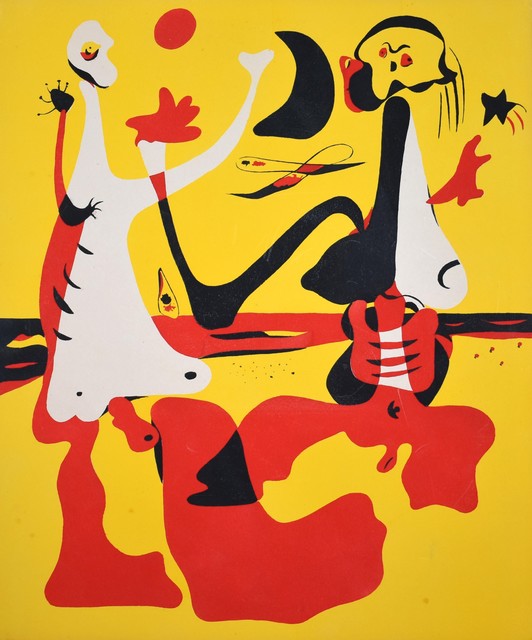
Title: Joan Miró: Pochoir
Description:
In the 1930s, [Joan Miró](https://www.
artsy.
net/artist/joan-miro) began experimenting with the pochoir (French for “stencil”) printmaking technique to create Surrealist works on paper.
Unlike the artist’s other favorite printmaking methods, [etching](https://www.
artsy.
net/collection/joan-miro-etchings) and [lithography](https://www.
artsy.
net/collection/joan-miro-lithographs), pochoir enabled him to create prints that most closely resembled his colorful gouache paintings.
To create pochoir prints, Miró worked with master printmakers (including the renowned pochoir-expert Daniel Jacomet) to cut intricately-designed stencils and brush them with ink before running his designs through the printing press.
The labor-intensive process produced unique, tactile prints, requiring a team of highly-trained experts to assist with the hand-coloring.
While pochoir fell out of favor in the mid-20th century due to its costly production, Miró continued to use the stencil-technique throughout his career.
Related Results
Painting (Spanish Dancer)
Painting (Spanish Dancer)
In this witty, fanciful painting, Surrealist Joan Miró combines vivid symbols of Spanish dance—a colorful mantilla, a flared skirt, and a pointed shoe—to convey the rhythm and subt...
[Orla of the Faculty of Medicine of the University of Barcelona]
[Orla of the Faculty of Medicine of the University of Barcelona]
Orla of the 1901-1902 course of the Faculty of Medicine of the University of Barcelona with portraits Pupils name, from top to bottom, from left to right: Joseph Abad Valdés, Ramon...
Joan Miró: Works from Album 19
Joan Miró: Works from Album 19
These works from 1961 are from Miró’s acclaimed portfolio, Album 19 published by Galerie Maeght, Paris. The works invoke Miró’s semi-abstract shapes, amoebic forms, and dream-like...
Joan Miró, Dibujos y Litografias, Camilo José Cela: Joan Miró (Drawings and Lithographs, Camilo José Cela: Joan Miró) (C. bks 56) (1959)
Joan Miró, Dibujos y Litografias, Camilo José Cela: Joan Miró (Drawings and Lithographs, Camilo José Cela: Joan Miró) (C. bks 56) (1959)
Three llithographs in colors, on one sheet of wove paper, the full sheet, folded (as issued), with accompanying unbound book, all contained in the original green cloth and paper-co...