
Search engine for discovering works of Art, research articles, and books related to Art and Culture


Javascript must be enabled to continue!
The Judgement of Solomon
View through National Gallery of Denmark
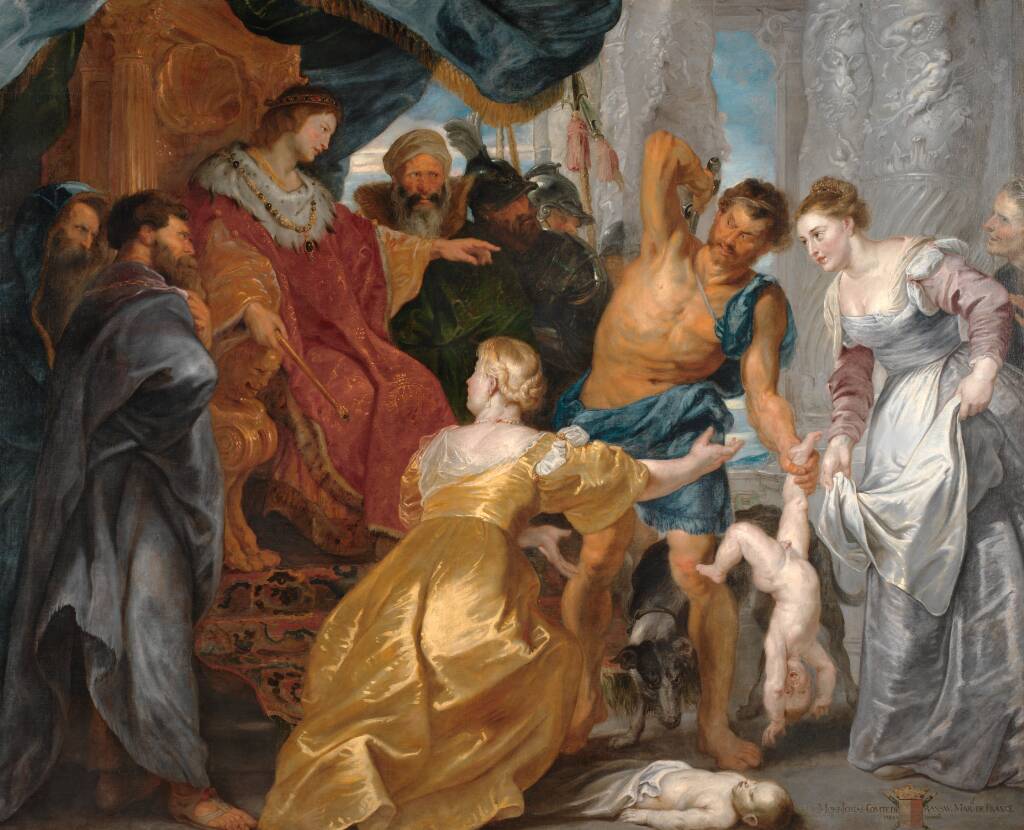
The first Book of Kings in the Bible (3:16-28) tells the story of how King Solomon had to pass judgment in a case concerning two prostitutes who lived in the same house and had given birth at the same time. One of the children died shortly afterwards, and now both women claimed the living child as theirs.
King Solomon’s wisdom and sense of justice led him to have a sword brought in and to order the living child cloven in two so that the women could share it. This order provoked the desired response in the true mother who gave up her half in the hope of saving the child’s life.
The painting's warm and cold side
The painting has a warm and a cold side. This polarisation concerns both the grouping of the colours and the story itself. The warm colours - the yellow garments of the true mother, Solomon’s red cloak and golden throne - against the cold hues - the executioner’s blue sash, the false mother’s icily white dress, and the twisted silvery columns behind her.
The painting made by Rubens' workshop
Rubens is a master of arranging compositions to form natural narratives. In this case, however, he did not do much of the brushwork himself. The painting is believed to be a product of his lucrative workshop where a group of highly skilled painters translated the master’s own oil studies into large finished canvases.
Værkdatering: Ca. 1617
afsluttet: senest afsluttet 1619, hvor maleriet afspejles i et maleri dateret 1619-22 af Gaspar de Crayer
Title: The Judgement of Solomon
Description:
The first Book of Kings in the Bible (3:16-28) tells the story of how King Solomon had to pass judgment in a case concerning two prostitutes who lived in the same house and had given birth at the same time.
One of the children died shortly afterwards, and now both women claimed the living child as theirs.
King Solomon’s wisdom and sense of justice led him to have a sword brought in and to order the living child cloven in two so that the women could share it.
This order provoked the desired response in the true mother who gave up her half in the hope of saving the child’s life.
The painting's warm and cold side
The painting has a warm and a cold side.
This polarisation concerns both the grouping of the colours and the story itself.
The warm colours - the yellow garments of the true mother, Solomon’s red cloak and golden throne - against the cold hues - the executioner’s blue sash, the false mother’s icily white dress, and the twisted silvery columns behind her.
The painting made by Rubens' workshop
Rubens is a master of arranging compositions to form natural narratives.
In this case, however, he did not do much of the brushwork himself.
The painting is believed to be a product of his lucrative workshop where a group of highly skilled painters translated the master’s own oil studies into large finished canvases.
Related Results
The Last Judgement, from The Last Judgement and the Six Works of Mercy, plate 1
The Last Judgement, from The Last Judgement and the Six Works of Mercy, plate 1
Engraving and Etching, The Last Judgement and the Six Works of Mercy...
Last Judgement
Last Judgement
The "Last Judgement" fresco at the Humor Monastery (in Suceava County, Romania)
was painted by Toma Zugravu (Thomas the Painter) of Suceava. It can be still viewed at the church...
Solomon Enthroned with Angels, Beasts, and Demons (painting, verso; Shi'a seals, recto), illustrated folio from a manuscript of the Shahnama by Firdawsi
Solomon Enthroned with Angels, Beasts, and Demons (painting, verso; Shi'a seals, recto), illustrated folio from a manuscript of the Shahnama by Firdawsi
This folio is half of what was a double-page frontispiece depicting King Solomon on the right and Bilqis, the Queen of Sheba, on the left. The Calderwood painting represents Solomo...
Solomon Praying the Lord for Wisdom, from "The Story of Solomon"
Solomon Praying the Lord for Wisdom, from "The Story of Solomon"
Engraving, The Story of Solomon...
Solomon and the Queen of Sheba
Solomon and the Queen of Sheba
Schönfeld was a German artist who spent a number of years in Italy where he is documented in Rome in 1633. The first known works by the artist are drawings and reflect his interest...
Visiting the Imprisoned, from The Last Judgement and the Six Works of Mercy, plate 7
Visiting the Imprisoned, from The Last Judgement and the Six Works of Mercy, plate 7
Engraving and etching, The Last Judgement and the Six Works of Mercy...
Sheltering the Strangers, from The Last Judgement and the Six Works of Mercy, plate 4
Sheltering the Strangers, from The Last Judgement and the Six Works of Mercy, plate 4
Engraving and Etching, The Last Judgement and the Six Works of Mercy...